Do you fish a hopper-dropper fly rig? It’s a method of fly fishing which utilizes a large fly that can be seen (think strike indicator) and tying a dropper to the bend of the hook. The dropper could be a nymph or an emerger. But what about a dry fly? Why not?
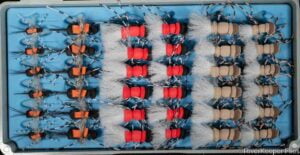
A traditional hopper-dropper fly rig will begin with a high floating dry fly at the end of a standard 7 1/2′ to 9′ leader. It could be a grasshopper fly pattern, but it doesn’t have to be. Why not tie on a Chubby Chernobyl, RiverKeeper October Caddis, or Stimulator? Use any fly that is easy to float. The key is you need to SEE it!

Next, tie an improved clinch knot onto the bend of the hook with 6″ to 24″ of 5X or 6X tippet. Match the tippet length to the depth in the water column you wish to fish.

Lastly, use another improved clinch knot to tie on a nymph or emerger. Most of the time it’s a bead-head nymph to quickly get the fly down to the feeding fish in the water column.
Cast your flies upstream and allow it to float towards you in a dead-drift fashion. That’s it. Easy.
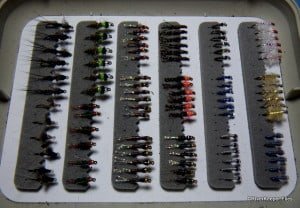
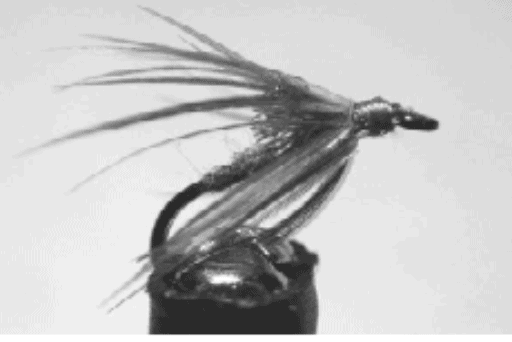
This time of year, put on a fly to imitate the small mayflies hatching. Try a $3 Dip, Copper John, Pheasant Tail Nymph, Prince Nymph, or a RiverKeeper Soft Hackle Cripple in size 16 – 18.
You can use this technique any time of year. Just keep an eye on the big floating fly and when it moves, set the hook. In some cases, a fish may rise to your “hopper” or indicator fly. I’ve had that happen!
The only difficulty with this technique is the chance of tangling your flies during a cast. The solution? Just slow down your casting stroke a second or two. That will create a big open loop and minimize the chance of tangling.
Now that you’re an expert with the hopper-dropper fly rig, how about using it with dry flies?
I’ll use this technique during a late summer night when Rusty Spinners are falling and the fish key on them. I admit it…I have problems watching a size 16 – 18 Rusty Spinner that lies flat on the water.
Or…have you ever been in a situation where the fish are rising like crazy and you tie on a small dry fly and cast your fly to those rising fish…and aren’t sure if the fish are rising to your fly? Sometimes the only way to see your fly is with some extra help…hence the hopper-dropper fly rig.
Just tie on a small dry fly as the dropper instead of a nymph. Easy, right?
It’s a great way for beginning fly fishers who have difficulties finding those tiny flies on the water.
Here is a size 6 Chubby Chernobyl and size 22 RiverKeeper Soft Hackle Cripple – BWO.

I use the hopper-dropper fly rig at this time of year when I use tiny flies…size 18, 20, and 22. Why? Because that’s what is hatching. Watch for those Blue Wing Olive mayflies hatching all winter long.
Give it a try. Let me know how it works.
(Check out my Resources page for a link to the improved clinch knot in the Fishing Knots section.)