It’s that time of year where I start to think about pulling out my Euro nymph rod and head to the river. You know how much I enjoy fishing dry flies, but hatches at this time of year can be very short, like 20 minutes, or nonexistent. If I want a chance at hooking up, I better be prepared to go deep where the fish are. I’d like to catch a few fish, so it means preparing for winter nymph fishing.

For me, it’s a different mindset. Here’s what I need to do:
- Pull out my Beulah 10 foot 3 weight rod.
- Find my reel with the Rio Euro Nymph line.
- Check my leader to see if I have a tippet ring tied on.
- Make sure my Euro nymph fly box is in my fishing pack.
Just writing down the list helps prepare. I don’t think it will take long at all. This could be done in less than half an hour. But it all needs to happen before heading to the river.
Collecting rod, reel, and flies is the easy part. For some reason, I don’t look forward to rigging the terminal section with tippet sections and flies.
I know, weird.
I can see you now, reading this post and asking, “what is the big deal?”
The answer is I’m a simple guy. Just tie a fly on the end of my tippet, look for rising fish, and cast.
Five knots are required to fish the method I use. If you snag the bottom and lose everything, five more knots are needed.
Have a strike and set the hook only to have it caught in the tree behind you? Yup, five more knots.
Now you know why I like to dry fly fish!
Perhaps this is the feeling beginner fly fishers have.
It really is simple though. I wrote about my Euro nymph setup in the Effective Methods for Fishing Two Nymphs post recently.
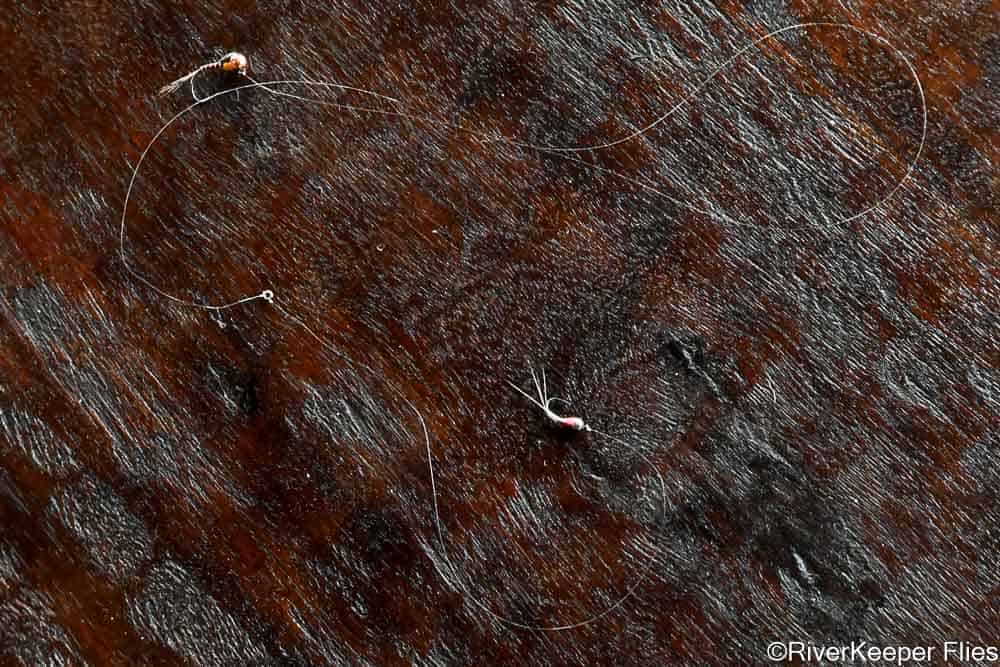
I tie a tippet ring to the end of my leader and attach an 18″ piece of tippet with the heavier nymph to the tippet ring. The dropper is a 6 – 8″ piece of tippet knotted to the tippet ring with a small nymph attached. This method eliminates slack to feel the fish eat the fly.
The result is a heavy nymph as a “point” fly that bounces along the bottom where the fish eat nymphs floating downstream. The lighter fly might be 6 to 8 inches above the heavy fly to entice the fish.
The design of a jig hook allows the fly to invert to prevent the hook from snagging the bottom. That’s the theory at least and it works really well.
I use tungsten beads on all my jig hooks and perdigon nymphs. They are about twice as heavy as brass beads. In addition, slotted beads used on jig hooks are heavier than a standard tungsten bead head. So if you are looking for a heavier fly, select one tied on a jig hook.
Here are my three favorite Euro nymphs for this time of year.
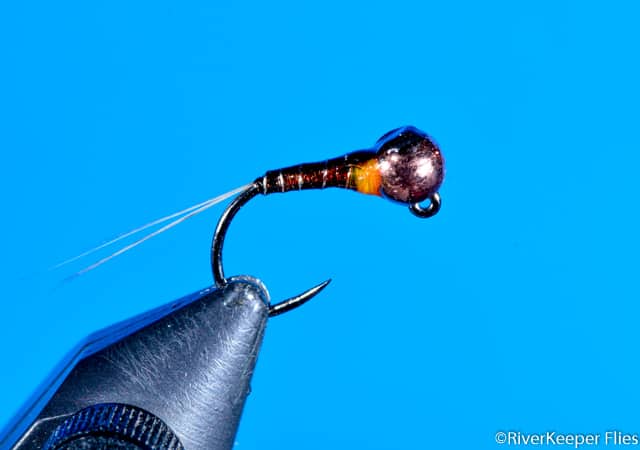
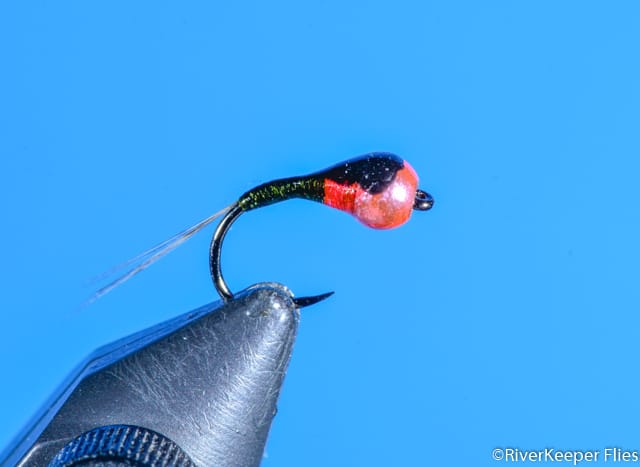

I like to use a #14 Pheasant Tail Perdigon variant I tie for the heavy, point fly. A #16 Olive Perdigon works well for me in the winter.
Here is a cheat sheet to a few Euro posts I’ve written:
- Jig Nymphs for Euro Nymphing (12/18) – The beginning of my jig hook fly tying journey.
- More Euro Nymphs (2/19) – Tying my first perdigon nymphs.
- Winter Fishing with Euro Nymphs (3/19) – New to me perdigon nymphs.
If you are new to the Euro nymph style of fishing, be sure to read my friend Jeff Perin’s description from 2018 entitled Euro Nymphing Updates. He owns The Fly Fisher’s Place in Sisters, OR and is very knowledgeable on this style of fly fishing.
One last thing before I go. I’ll be teaching a Zoom fly tying class next week on 1/21 at 5 pm PST. The two flies will be an X Caddis and Sparkle Dun. These are two flies I fish a lot and are easy to tie with the proper deer hair and technique. Did you see my Selecting the Proper Deer Hair to Tie Sparkle Dun and X Caddis Flies post last week? If you’d like to attend, leave a Comment below and I’ll get you the link.
Thanks for being patient with me. I think I’m ready to fish!
Enjoy…go fish, stay safe!


I would like to attend the zoom tying on the 21st.
Thanks, M
I’d like the link for your fly tying session.
John
Thanks for this and other postings on the Perigon style nymphs. I have taken the dive into them and I am enjoying the typing. One question: given that the flies will likely ride with the hooks up, who do we tie draw the wing cases on what will be the underside of the fly? I suspect that real bugs tumble and twist in the water, so it may well be a mute question.
John
Thanks for leaving a Comment.
I really don’t know the answer, but I believe you answered your own question. At least that’s what I believe. I’ve read where tyer’s put the wingcase on the bottom of the fly, but I honestly don’t think it would make a difference.
John
please send me the link for the ZOOM fly tying class 1/21
thank you
Hi John,
I’d like to attend as well! I’ve always enjoyed your tying in person so this will have to work instead!
Rick
Please send me the link to the zoom session.
Hi John:
Thanks for the Winter Nymphing piece! It is very helpful and clear as to set up.
Have any advice re: kind of tippets?
Please send me the ZOOM link for the 1/21 tying class.
Dalton Miller-Jones
John
I would like to join you for the Zoom class on the 21st. Please send the link. Thanks!
Milt
Please send the zoom link, many thanks!
Please send me the ZOOM fly tying link for your presentation 1/21
Thanks
Wally
Wallyjo1@yahoo.com
John,
Please send me the link for your upcoming Zoom class (1/21); I learn something every time I watch you tie.
Many thanks for all you share with us, John – Phil Mickel
If you would please send me the link to your zoom class on 1/21.
Thank you.
Bob
Please send a link for the Zoom tying session on January. Thank you
Hi John,
I really enjoyed this post. The picture of the PT Paragon (above) would make a good logo shot for your company. Take care & …
Tight Lines – Al Beatty