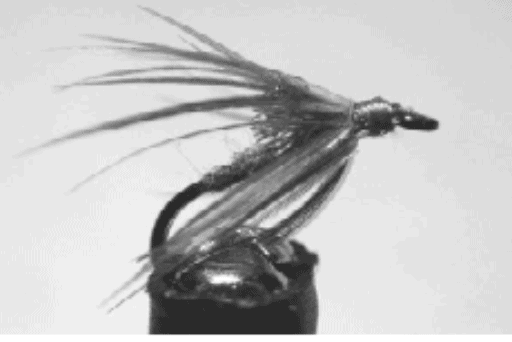
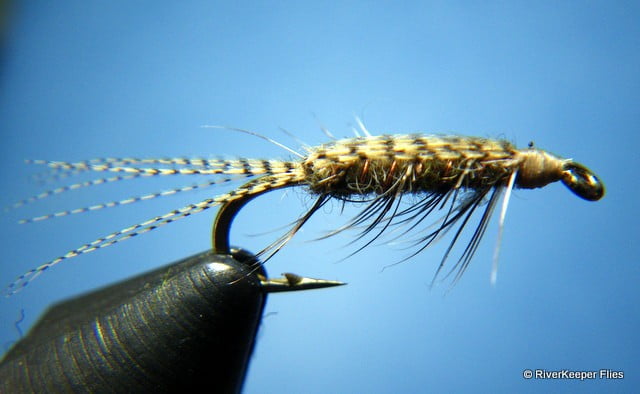
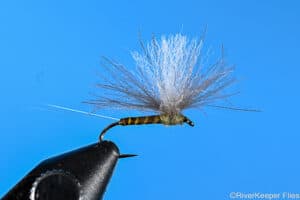
This week’s Throw Back Thursday Fly is Denny Rickard’s Callibaetis Nymph.
I started my fly fishing journey fishing rivers. As I ventured to new water, I was intimidated by lakes. I didn’t understand the structure and where the fish lived in them. But I was aware big fish lived in lakes!
My wife and I took a class about fishing lakes from Denny Rickards many years ago. He talked about the structure, how to retrieve a fly, and successful flies.
We purchased our first lake fly lines from him, a Cortland intermediate sinking line. He taught us how to use them.
I was impressed by the simple fly patterns he developed and their ability to catch fish. I purchased his book entitled Fly-Fishing Stillwaters for Trophy Trout (1997). Doesn’t the title say it all? Why wouldn’t I want to catch large, trophy trout?
Denny’s Callibaetis Nymph is one of the handful of flies I tied that were listed in the book. Others include Denny’s Seal Bugger, Denny’s A.P. Emerger, and my favorite Denny’s Stillwater Nymph.
Several of Denny’s fly patterns utilize Wood Duck in the fly. The tail and wingcase of this fly is a good example. The downside is the material is prone to break when a fish’s tooth breaks it. But it does work!
If you can find this book, buy it. Even though it’s 24 year’s old, it’s still has a lot of valuable information in it.
Tie up a few while you are waiting for the lakes to open later this year.
Enjoy…go fish, stay safe!
(John Kreft is a participant in the Amazon Services LLC Associates Program, an affiliate advertising program designed to provide a means for sites to earn advertising fees by advertising and linking to amazon.com.)

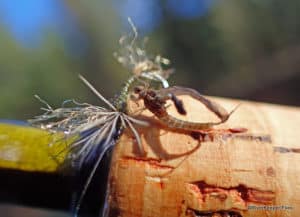

I just rib the wire “over” the shellback and hackle and the shellback breakage problem isn’t really an issue. Just had a banner day on a Utah stillwater fishing a pair of these nymphs on 4X fluoro and a floating line sight fishing to big rainbows feeding at the surface mainly on midges, but with a smattering of Callibaetis mixed in. Its now my new favorite Callibaetis pattern. 🙂
Great idea!
Seal Buggers are a standard go-to fly for me; purple and black or olive and burnt orange depending on the light conditions. 25+ years now these have caught fish!
Been using his flies for 25 years now John, they are timeless and a great addition to any flyfisherman’s arsenal. I do find that the Callibaetis Nymph shellback is prone to breaking after a fish or 2, but I’ve still had success using the “broken” fly. His newest book you mention is the largest of his 4 books, and contains all the stillwater info fly fisher could use in a lifetime. A great resource!
That’s my favorite fly by Denny. You can get any of his books direct from Denny. Or I have several copies listed for sale.