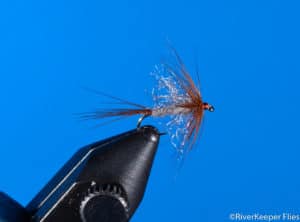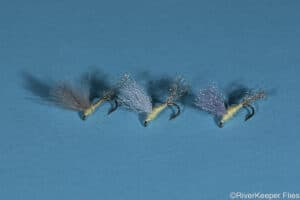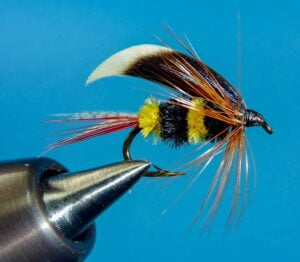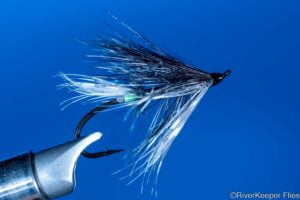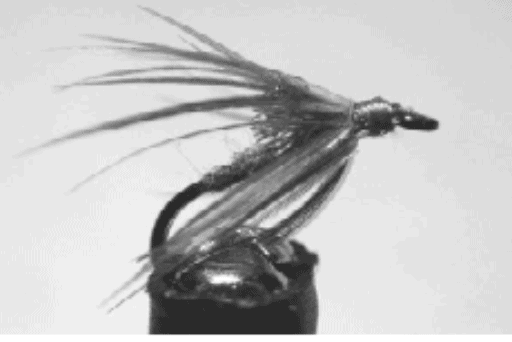
This week’s Throw Back Thursday Fly is Dan Bailey’s Mosquito.

This fly was from a collection of flies tied by Dan Bailey. I was fortunate to be able to photograph a total of nine Bailey flies – a Blonde Wulff, Light Cahill, Grey Hackle, Dark Cahill, Ginger Quill, Black Bivisible, Black Gnat, Fan Wing Royal Coachman, and this Mosquito. I hope to tell more about these flies in the future.
Dan Bailey started a fly shop in Livingston, MT. Here is what the current shop looked like when I was there a couple years ago.

Bailey moved to Montana from New York City in 1940 or 1941. Here is an excerpt about Dan taken from the Dan Bailey Fly Shop website.
“In 1936 Dan was a professor at Brooklyn Polytechnic Institute in New York City, and he was working on his doctorate in atomic science at NYU. He married Helen in 1936 and they drove to Montana for their honeymoon. Dan spent the summer camped on the Madison and Gallatin Rivers. Helen had to go back to New York City and work. Again they came back for the summer of 1937. Driving from Bozeman to Livingston Helen drove off the road, which was a winding mountain road. The car had to be towed to Livingston to be repaired and it took three days for the repairs. As Dan walked around Livingston he found a small space to rent on Park Street a block away from where we are located now. The cost was $20.00 a month. Dan found during the previous summer and the summer of 1937 he was unable to buy supplies for fly fishing and got the idea there was a need for a fly shop.
Back in New York he finished all his course work, exams and orals but never finished his thesis. He moved to Livingston in the summer of 1938. Helen came to Montana on vacations but did not move to Montana until 1940 or 1941. Had he stayed in New York City and finished his doctorate, he would have been in the middle of the Manhattan project.
His early years were very difficult but being a fly tier he sold flies to other outlets. As he told me in the early years most of the fishing supply outlets were bars. After his death in 1982, a customer sent me a copy of a classified add from a July 1937 Outdoor Life. “Send for free folder today. (Trial assortment, 5 for $1.00). Dan Bailey, 217 West 10th Street, New York City. After July First, send mail to Ennis, Montana. (The good old days) As you can see this was the start of our mail order business.”
Enjoy…go fish!