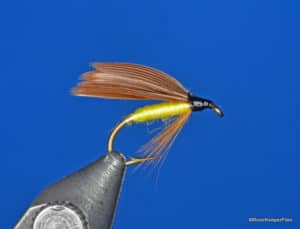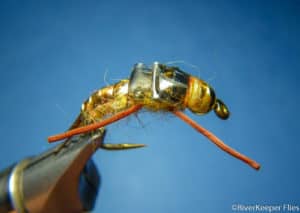
Tying a CDC Little Olive Stone

I shared this fly about a month ago and decided to create a video tying a CDC Little Olive Stone. The fly imitates the size 16 and 18 stoneflies we’ve seen on the streamside vegetation and flitting on the water.

CDC Little Olive Stone Flies | www.johnkreft.com

You might mistake them for Caddis, because they fly in a similar manner, but capture one and you’ll see the tell-tale sign of a Stonefly with the wings flat accros its back.

Little Olive Stones on Metolius River | www.johnkreft.com

Several fish have risen to this fly. I love the segmentation a turkey biot provides and the CDC silhouette looks like wings moving. You could also use stripped peacock herl for the fly, but I prefer the turkey biot as I can select smaller sizes for the body.

I decided to create a video demonstrating how I tie the CDC Little Olive Stone.

Be sure to follow my RiverKeeper Flies YouTube channel as I’ll publish another video soon demontrating how I tie an Upright Biot Body Dun.

Upright Biot Body Dun | www.johnkreft.com

The impetus for this fly is the Flav hatch and fish ignoring my other offers.

Olive Dun | www.johnkreft.com

Enjoy…go fish!

Similar Posts

  • Winter is Fly Tying Season

    As I write this week’s post, I look out the window at a few inches of snow covering the ground. It’s winter. And I’ve always said winter is fly tying season. I’ve been working on a couple of orders for Custom Flies. In fact, I finished this order last night. He doesn’t plan to use them until at…

  • Griffiths Gnat

    The Griffiths Gnat is this week’s Throw Back Thursday. The fly was named after George Griffith, one of the founders of Trout Unlimited. George was one of 16 men who gathered at his home on the Au Sable River in 1959 to create TU. It imitates midges, midge emergers, and midge clusters.  Still works

  • Light Spanish Needle

    This week’s Throw Back Thursday Fly is the Light Spanish Needle. The Light Spanish Needle is another old fly pattern listed in The North Country Fly – Yorkshire’s Soft Hackle Tradition (2015) by Robert L. Smith. Many of these older soft hackle fly patterns come from the Yorkshire Dales in northern England. Wharfedale is a small area…

  • Salmonflies Are Here

    I’ve heard Salmonflies are here! They’re out in force on the Deschutes River. It’s an exciting time of year as the fish key on eating these big bugs. I’ve heard from others these stoneflies are all over the grasses along the river. Golden Stones won’t be far behind. They are a little smaller and lighter…

  • Filling the Provider Box

    November 1st is right around the corner and I’ve talked in previous posts about how fishing changes at this time of year. In the last week or so, I’ve noticed it’s come a little early.  What’s a fly fisher to do? It might be too early to begin filling the provider box, but that’s exactly…

  • Lunn’s Particular

    This week’s Throw Back Thursday Fly is Lunn’s Particular. William J. Lunn was the river keeper for the Houghton Club’s fifteen mile stretch of the river Test in England from 1887 through 1931, a total of 45 years.  Lunn is credited with the first representation of the Rusty Spinner. The fly design incorporates a key component…

Leave a Reply

Your email address will not be published. Required fields are marked *