This week’s Throw Back Thursday Fly is the Red Clock or Pheasant.
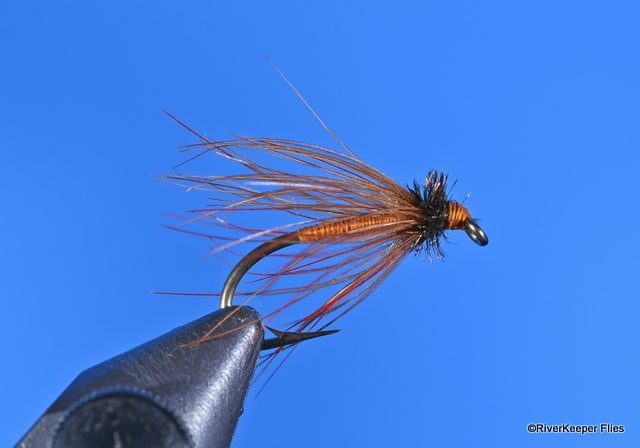
I decided to tie an old soft hackle fly since I’ve been tying so many of my RiverKeeper Soft Hackle Cripples lately. I love the simplicity of these flies and am fascinated by older soft hackle fly patterns…or they would have called them “dressings”.
I found the Red Clock of Pheasant in Robert Smith’s The North Country Fly – Yorkshire’s Soft Hackle Tradition (2015). Many older fly patterns come from the Yorkshire Dales in northern England. Wharfedale is a small area of of the Yorkshire Dales.
Many of the older books I’ve seen are about the Yorkshire anglers from this region. In Smith’s book, he discusses the first recorded documentation of these flies by William Lister in his 1712 fishing diary.
Subsequent authors continue to list many of the same flies, although “variants” begin to appear as time passes. Examples include:
Jonathan Pickard (1820) – A Description of Flies for the Season – “Orange silk, peacock harl in the head a red feather from a pheasant neck.”
John Swarbrick (1817) – List of Wharfedale Flies – No.12 & 10 “The feather is taken from a phesant Neck Cut the Black ends of the best feathers is upon the top of the Neck a Cock pheasant Oringe silk Harld at the Head with peacock feather.”
Joseph Wells The Wharf Dale List from the 1842 The Contemplative and Practical Angler – “Pheasant’s breast or neck, orange silk, peacock harl head.”
T. E. Pritt also includes the Red Clock or Pheasant in his popular book North Country Flies (1886). Smith is quick to point out several inconsistencies where fly pattern descriptions seem to be inaccurate. This may be the case with this fly because it appears to change;
No. 16 Red Clock or Pheasant
| Wings: | Hackled with a golden feather from a Cock Pheasant’s neck, or from a small red cock’s feather |
| Body: | Yellow silk, with a twist of peacock herl next to hackle |
| Head: | Peacock herl |
Pritt’s remarks: “Kills well sometimes on bright days in March and April.”

It just happens that one of the tyers I watch on a regular basis tied his version of the Red Clock or Pheasant. Here is Davie McPhail tying the fly.
Be sure to check out my Links to Free Old Fly Fishing and Fly Tying Books.
Enjoy…go fish!