Our last day of fishing Patagonia in Chile found us fly fishing the Upper Rio Simpson with Coyhaique River Lodge. We weren’t sure what the upper river might have in store for us, because we enjoy the walk/wade experience. Our only other time fly fishing the Rio Simpson was 18 years ago when we waded the bigger water downstream. Little did we know, we’d be in for a treat!

I hope I got your attention with this image. Read about this beauty below that ate a dry fly. You can see the tippet for the dropper coming out of its mouth.
Much like the other days we fished during our stay at Coyhaique River Lodge, we turned off the main gravel road and through a fence onto private property on our drive to the river. A slow, double-track path led us to the river where we donned our waders and strung rods.

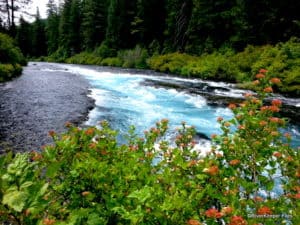
Here is the view from where the truck was parked looking upstream…

…and the downstream view. We found long runs followed by slower water before changing to a small riffle/run.

We got a late start the day, arriving at 12:45. It took us a little while to find fish, but we made up for the late start mid-afternoon as the water warmed and the fish rose to our dry flies.

As I remember, the Purple Haze and Fat Albert hatch was on.
After starting our day with a short walk below the truck, we worked our way upstream, alternating the fishable water. We were surprised to see the quality Brown trout continue to rise for our flies.
We had a good laugh with our guide Zack. A couple of smaller Rainbow came to hand and we asked if there were any Browns in the river. He responded we’d probably see mostly Rainbows, as most of the Browns were farther downstream. A couple hours later after only catching Brown trout our experience was much different.

Here is a closeup of the Brown. Notice it doesn’t appear to have the typical blue spot on the gill plate?

At the end of our day, Dancingtrout found a nice run and several Browns rising to her fly, landing at least six ranging between 14 and 18 inches. These were quality, hard-fighting fish!

And a closeup of this beauty.

I had a great time capturing the moments with my Nikon!

Remember the first image of the jumping fish? Well, here is the story behind it.
Dancingtrout was working the water around and under this tree while I tried my luck below. She was attempting to get a cast so the fly would dead-drift into the shadows under tree branches. I can’t tell you how many times we found water like this in Chile and Argentina! Incredibly difficult casts with a dry/dropper combination. Trying to turn over a beadhead dropper attached to a larger dry fly is tough to do. Aiming for a spot by the tree without finding the fly tangled in a tree branch…well, you get the picture.
She managed to get a great cast and the next thing I saw was a bent rod. I could tell it was a big fish by the way it was fighting.

Fifteen seconds later, a big Brown rockets out of the water several times and I held the shutter release down and was very lucky to capture the moment.
Looks like a dropper wasn’t needed as the big Brown ate a Fat Albert.
The fish continued to fight hard and got close to the net. It took off again and ended up breaking off on 3X tippet, or 8 pound test. We all got a good look at this fish and guessed it was over 24 inches. As the saying goes, the big one got away. We still talk about this fish.
And with that, we said adios to Coyhaique River Lodge and Chile. Onward to Argentina as our adventure continues!
Enjoy…go fish!



That big rainbow looks pretty brown John!
Yup…don’t know what I was thinking. Must have been the jet lag! My wife noticed it and I’ve already corrected.