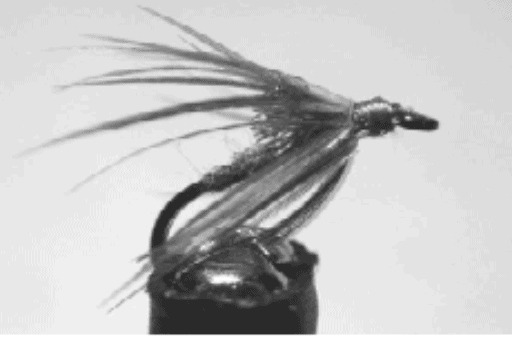
This week’s Throw Back Thursday Fly is the Sierra Bright Dot fly.

This is an attractor-style “fore and aft” fly pattern developed sometime in the 1950’s for the eastern slopes of the Southern Sierra mountains for Golden Trout.
I was asked to tie a few dozen Sierra Bright Dots for a customer in sizes ranging from 12 – 20 and decided to Google the fly pattern. I’ve used Fly Fishing the Sierra website for research of older flies featured on RiverKeeper Flies in the past. Turns out the fly is listed there, and I decided to feature it for you today.
The name Bright was in honor of Dorothy Bright whose husband owned a mine at Convict Lake or named Monte Diablo Lake back in the day. The lake’s name was changed after an 1871 episode where 6 escaped prisoners attacked the mining village the Brights owned. Interesting story, isn’t it?
I understand this is an effective fly pattern the the Sierra’s and other waters as well.
Enjoy…go fish!


Mickey always had those who tied it for the shop use Flymaster Flame colored thread rather than red. Per my memory he sold most of them wholesale to a shop on the east side of the Sierras. For some reason it was not a particularly popular fly sold out of the shop here in Visalia.
Thanks for the Comment, Wayne.
John
This is fun! Thanks Al and John for your comments. Brings back memories…
I first learned of the Sierra Bright Dot from the “Buzz” Buszek fly tying materials catalog out of Visalia, California. Buzz had recently passed, tragically, at that time and his wife Virginia and son-in-law Mick Powell ran the shop.
They supplied materials to commercial tyers up and down the west coast. Ira Lindgren, Darwin Atkins, an easterner named Dave Whitlock, Dick Winter, Polly Rosborough, Cal Bird, and others were the old guard.
The young guard was a batch of younger tyers who lived during steelhead season in a cabin on the Umpqua and tied flies at the kitchen table, and a retread college student supporting a young family in Chico, California. They all tied big commercial orders for Orvis (no quality imports in those days) and bought their materials from Buszek’s.
I learned years later that the guys in the cabin on the Umpqua were Dennis Black (his cabin,) Brant Hansen, Ed Schroeder, Jack Dennis, and Randall Kauffman. I was the guy in Chico. Mick Powell told us, separately when we called in orders, “You ought to meet / those guys in Oregon / that guy in Chico.” We didn’t hear each other’s names, then, and only put the story of our beginnings together much later.
The Sierra Bright Dot was responsible for my spinoff pattern that I called the Sierra Nugget. Walton Powell’s favorite pattern, the Clyde Fly, and his family’s Buzz Hackle were other fore-and-aft flies that had big followings in the Central Valley and eastern Sierra rivers. I think Bergman had some fore and aft patterns listed in his volume, Trout. Today we’re down to the Renegade as a popular fore and aft tie.
When I get the rubble cleared off my bench I’ll tie some samples and send them to you. They still produce and are fun to tie.
Thanks for your Comment, Chuck!
Looks like I brought back a few more good memories for you. I’ll look forward to your samples.
John
Hi John,
I had forgotten about this fly until recently seeing it once again on your site and until now, I didn’t know the history behind it. Back in the early 70s, I spent 5 years working in Yosemite Park as a telephone technician where I used this fly a lot. I don’t know why I let it slip into obscurity, but it will soon be back in my personal fly boxes right next to my favorite fly, the Renegade. Side note: When I “worked the park,” there wasn’t any fly shops for many miles around, sometimes I ran out golden pheasant tippets for the tail. I found moose worked just fine as a substitute until my order of more golden pheasant arrived in the mail from Orvis or Herter’s. Take care & …
Tight Lines – Al Beatty
Thanks for leaving a Comment, Al. I brought back some memories for you and Chuck Stranahan who also left a Comment.
John