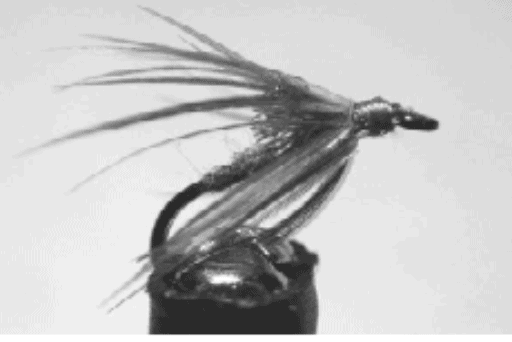
This week’s Throw Back Thursday Fly is Theodore Gordon’s Bumblepuppy.
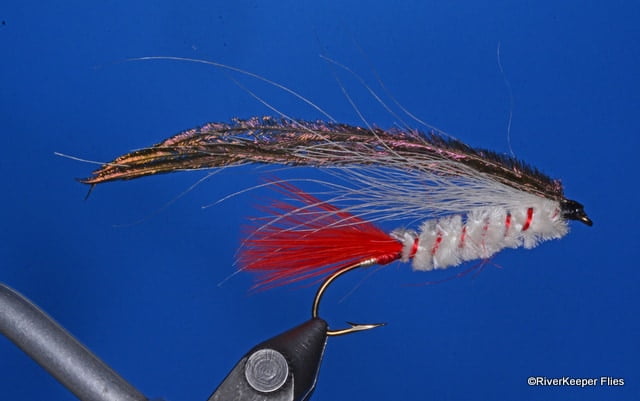
To be honest, when I heard the name of this fly, I thought it was a joke. After a little research, I think the joke is on me.
I’ve been reading Mike Valla’s book entitled The Founding Flies – 43 American Masters, Their Patterns and Influences and low and behold, Valla dedicates lots of space for Theodore Gordon’s Bumblepuppy. A friend gave my wife the fly in the picture and I thought it was a great time to highlight this old fly pattern. I’ve added Valla’s book to the list of fly fishing and fly tying books I recommend.
The Bumblepuppy was a fly developed by Theodore Gordon (1854 – 1915) somewhere around 1880, according to Roy Steenrod, a friend and fishing partner.
Joseph D. Bates, Jr also wrote about the Bumblepuppy in his 1950 book, Streamers & Bucktails, the Big Fish Flies. He included quite a bit about this fly. One such entry was a quote by Theodore Gordon published by John McDonald, who edited the papers of Gordon and published them in The Complete Fly Fisherman (1947) and it states:
“The ‘Bumblepuppy’ is great medicine – there is no doubt of that, after years of trial. Attach a well-made specimen to the end of your cast and play is in clear water. You will see at once that it is very much alive and shows up wonderfully…”
Bates includes more information in Part 4 of his book – The Histories and Dressings of Other Prominent Patterns. He begins “This historic fly, originally tied both as a bucktail and as a streamer, evidently is the first of all the modern patterns of this type. Originated by the famous Theodore Gordon, creator of the popular Quill Gordon and father of the American dry fly, the Bumblepuppy actually is not one fly but rather several related patterns as developed by Gordon over many years prior to his death in 1915.”
In addition, he provides several detailed fly pattern descriptions. The first one is from John McDonald.
| Materials | |
| Head: | Red or yellow chenille, or black, plain varnished |
| Tag: | Silver and red silk |
| Tail: | Scarlet ibis, two mated feathers, back to back and quite straight on hook |
| Butt: | Red or yellow chenille |
| Body: | White silk chenille dressed full; not thin |
| Ribbing: | Medium flat silver tinsel |
| Throat: | Badger; large, long and lots of it |
| Wing: | White hair from deer, white bear or goat, over which are strips of white swan or goose |
| Shoulders: | Widgeon feathers, as long or longer than the badger |
| Cheeks: | Jungle cock, tied low (in line with the hook) |
The next fly pattern description is from Roy Steenrod, a game-warden friend and fishing companion of Gordon.
| Materials | |
| Head: | Black |
| Tail: | A dozen rather long fibers from a red hackle feather |
| Body: | White chenille |
| Throat: | About two turns of a red and a white neck hackle, to make a very long but not heavily dressed collar |
| Wing: | A very small bunch of white bucktail, extending slightly beyond the tail of the fly |
| Shoulders: | Four sections of a brown turkey tail feather; two for each shoulder. Each two are matched with the concave sides together to give the appearance of a single feather. They are tied on rather high, like the wings of a wet fly, but the two shoulders splay out to make a V when viewed from the top. The shoulders are nearly as long as the bucktail. |
Lastly, here is the fly pattern description is from Herman Christian who also was a fishing friend of Gordon’s.
| Materials | |
| Head: | Black |
| Tail: | A small bunch of red hackle fibers, rather long |
| Body: | White wool or chenille, rather heavy |
| Ribbing: | A single strand of red wool yarn |
| Throat: | About two turns of a red and a white neck hackle, mixed to make a very long but not heavily dressed collar |
| Wing: | A bunch of white bucktail, extending slightly beyond the tail of the fly. The lower half of the bunch of bucktail is clipped off at about half its length after it has been tied in. Over the bucktail is a wing of two long but narrow matched sections of a brown turkey tail feather, extending as far as the beginning of the tail. |
Note: The early Bumblepuppies were tied on regular wet-fly hooks, usually in size 4 or 6. This version is dressed on a long-shank streamer fly hook, size 2 or 4. Long hooks were not available during Mr. Gordon’s lifetime.
In one of the books I read, it stated there were over 20 versions of Theodore Gordon’s Bumblepuppy.
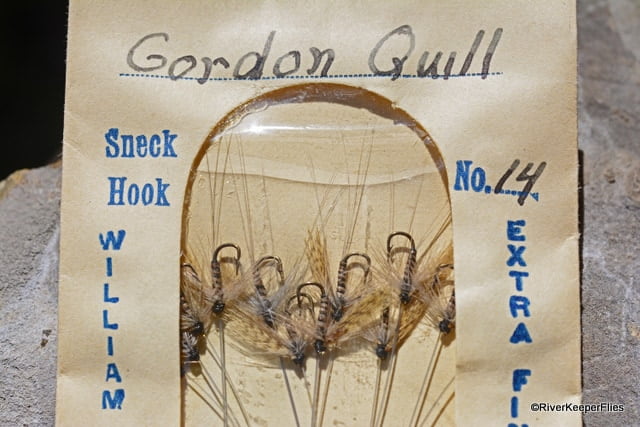
Perhaps Gordon’s most famous fly may be the Quill Gordon, a fly previously featured as a Throw Back Thursday Fly, actually twice. The second was a package of flies.
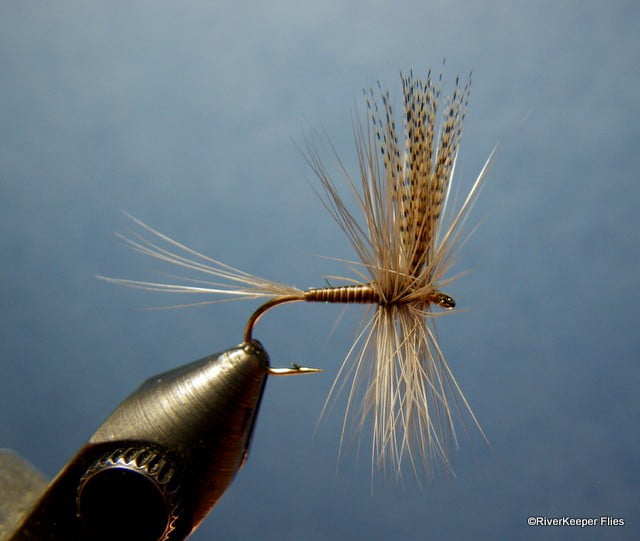
I’ll never make fun of Theodore Gordon’s Bumblepuppy again.
Enjoy…go fish!
(John Kreft is a participant in the Amazon Services LLC Associates Program, an affiliate advertising program designed to provide a means for sites to earn advertising fees by advertising and linking to amazon.com.)