I recently finished a fly order for a customer and thought you might enjoy my latest foray into tying Catskill dry flies. I’ve tied Catskill flies in the past which is how my customer found me through a Google search. The order included some classics as well as the series of Atherton dry flies.

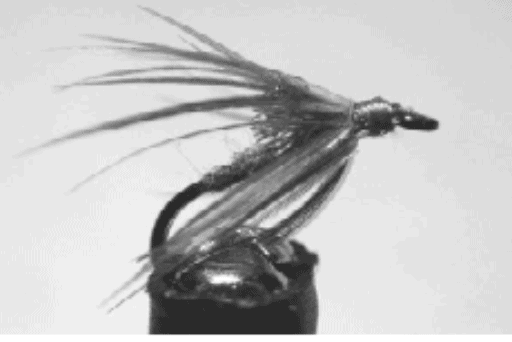
I’ll begin with Flick’s March Brown shown above.
While I enjoy tying this fly with the Wood Duck wings, they are not easy to tie. Proportions are the name of the game when tying these flies. And for consistency, I use the Dette hackle gauge.

The other material I tried to use, although not exclusively, were Charlie Collins capes and tailing material. While he no longer grows chickens for these feathers, I believe he still has inventory and sells them. Here is a selection I am lucky to have in my collection.
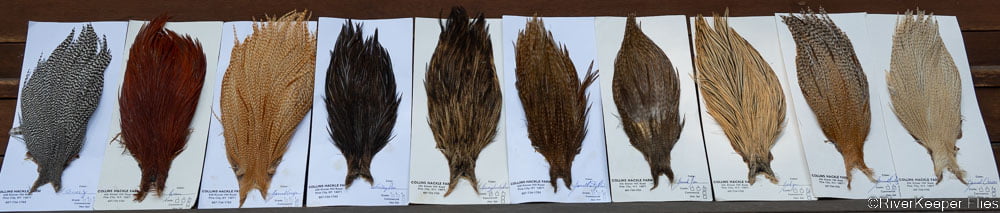
I love the natural colors of his capes.
Flick’s Red Quill is the next fly pattern. It was one of Flick’s signature fly patterns. Art Flick (1904-1985) was instrumental in popularizing this fly. The Red Quill imitates the Ephemerella Subvaria and uses a large stripped hackle from the Rhode Island Red rooster. I’ve used Collins hackle which I hope is similar to the original. An earlier version from Rube Cross utilized slate wings instead of wood duck fibers.

Next is the Quill Gordon. This is a fly created by Theodore Gordon before 1906. Gordon was born in Pennsylvania in 1854 and is recognized as the father of dry fly fishing in America.

The next set of flies were the Atherton dry fly series. What are Atherton flies you ask?
I featured the flies of John Atherton (1900 – 1952) back in 2022 when I highlighted older flies in my Throw Back Thursday Flies posts.
Atherton was an artist by trade and incorporated his impressionistic art into the flies he tied. His flies were created with “the appearance of life” as a central theme for the flies he developed to replicate colors and tones, textures, and light reflections combined in natural insects. Take a closer look at the flies and you’ll see the mixture of materials making the body and a round tinsel. For hackle, Atherton used mixtures of cree or brown, dun, and ginger mixed with grizzly to create the life-life image of the real insect. For a wing, he liked wood duck because of the “speckled look” created lifelike appearance.
Here are the Atherton No. 1 – No. 6; notice how the flies change in color from light to dark. Click on the links for a list of materials of each fly.


My customer said he planned to fill a fly box with these patterns. I’d like to see my 54 flies layed out in a fly box!
Enjoy…go fish!


Those flies are absolutely beautiful! I grew up learning to fly fish in the Catskills and those were the flies I tied and fished. I stopped at the Dette‘s every trip I made to that area. I haven’t tied Catskill style dry flies in quite a while, but you have inspired me to. I am nowhere near the fly tyer you are. Your flies are gorgeous. Thank you for the inspiration.
Thanks for the Comment and compliment! I don’t tie these often and it takes a few flies to tie them consistently. Having said that, I can still pick them apart.
John
Hi John, beautiful flies as always from your vise! I learned a lesson the hard way in the early 80’s while fishing Hendrickson’s Pool on the Beaverkill. It seems the male of the Hendrickson (Ephemerella Subvaria) is imitated by the Red Quill, but the female is imitated by the Light Hendrickson pattern. They look quite different and are 1 size apart also. Unfortunately for me, the Red Quills were the major hatch that day, and I only had the Light pattern with me. My order from Orvis hadn’t arrived yet! I was still pretty new to tying, so I hadn’t tied any of the Quills. 2 guys in the pool above me were hooking trout almost every cast, and I was struggling. I eventually had to clip the wings off another pattern that had a reddish body, and fish it as an emerger. That finally caught a few, but I have always wished I had some red quills with me that day! I always look forward to your Blog – keep ’em comin’!
Thanks for leaving a Comment Tim…I appreciate it.
John
John, I really enjoy seeing your flies! Very impressive. Especially the Athertons. Just beautiful!
Thanks Jim!
John,
Thanks for sharing this post. I always appreciate your approach to these since they tend to include both an instructional and historical approach to tying.
I’m especially excited by today’s post given that these were the flies that I began tying as a very young fly tyer. I see a lot of these posted on social media and the thing that I tend to see is mis-proportioned flies, so it was great to see that you mentioned the importance of that here.
How do you value these in your own fishing experience given the myriad of fly options? It seems to me that, while aesthetically appealing, these flies are not as “fishy” as some more contemporary patterns. I’d love to hear your thoughts on that.
Enjoy your weekend!
Joe
Thanks for Comment Joe. Interestingly, I don’t fish these. I tend to like flies where the body is closer to the water’s surface.
John