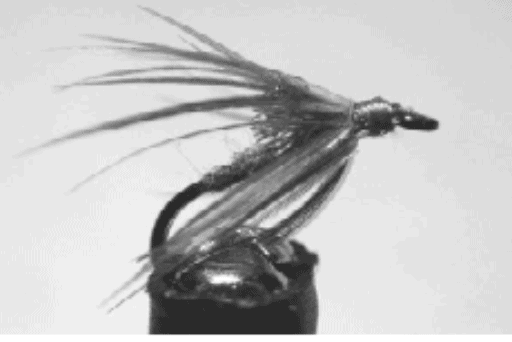
This week’s Throw Back Thursday Fly is the Sidewinder No-Hackle, by Doug Swisher and Carl Richards.

This size 18 fly was given to me recently by a friend who tied it a few years ago. I think he did a terrific job! Notice the small drop of Dave’s Fleximent at the tip of the wing, which is a technique to hold the hackle together. Just the right amount is needed. If too much is applied, the fly tips over.
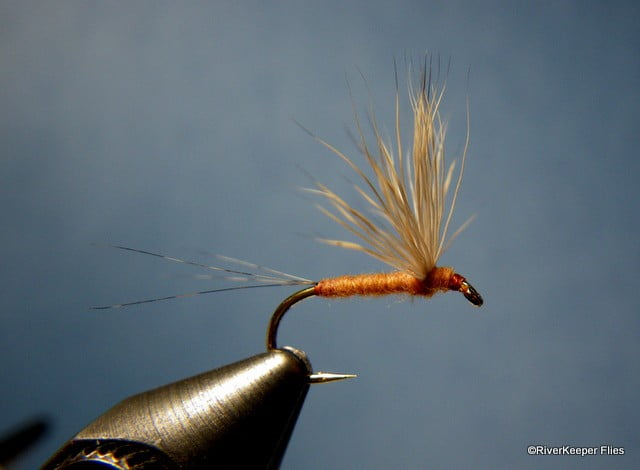
According to the information on Doug Swisher’s website, the Sidewinder No-Hackle started out in 1965 as the Hairwing No-Hackle. The original had a deer hair wing and tail. You might recognize the fly which was as Swisher calls it…re-invented by a different fly tyer and called it the Comparadun, switching out the deer hair tail for hackle fibers. Here is a March Brown Comparadun I tie.
The Sidewinder No-Hackle is a result of Swisher and Richards tweaking the fly in 1967 using duck quills along the sides of the fly’s body (and not on top of the hook) and creating a split tail with the use of a dubbing ball. If the fly is tied correctly, the two tails and wings provide what the designers called 4 outriggers to float the fly better.
I know Rene Harrop and Mike Lawson, both of Last Chance, Idaho, tied no hackle flies for the waters they fished the Henry’s Fork of the Snake River for the super-selective trout they fished for.
Looks like I have a little more research to do so I can find out how Rene and Mike came upon the pattern. But that’s for another day…
Enjoy…go fish!




John,
Thank you for the posting on the Sidewinder. At my age, I am attempting to learn and become a functioning tyer of the “No Hackle” style of fly. Your comment about learning some history fit into my search when I discovered an essay that Mike Lawson put on the web. https://www.henrysforkanglers.com/fishing-info/blog/the-nohackle-a-bit-of-history
The No Hackle is a great fly but learning the wings is the most difficult thing I have ever done at the vise. It is only knowing that the fly is so effective that keeps going.
I enjoy your web site and its teaching. Your are making us fly tyers better because of your dedication to teaching. Thank you.
John:
Know where I can have my broken graphite rod repaired? Damn those car doors!!