Rosborough Casual Dress Nymph

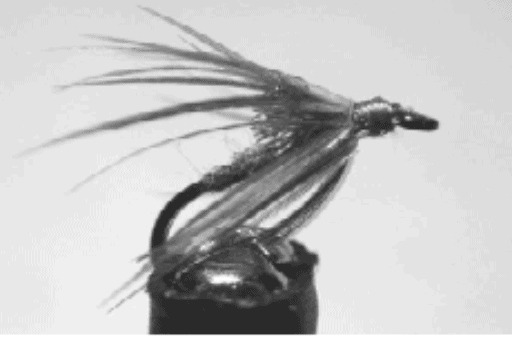
This week’s Throw Back Thursday Fly is the Rosborough Casual Dress Nymph.

Casual Dress | www.johnkreft.com

I found the fly on display at the International Federation of Fly Fishers Museum in Livingston, MT and took this picture of the Rosborough Casual Dress Nymph through the glass display in a dark room. I think it turned out quite well. It was one of several flies in the collection of Polly Rosborough. It’s is one of several flies in a display entitled Polly’s Proven Killers.

The Rosborough Casual Dress Nymph can be used to imitate a mayfly, stonefly, or caddis. Polly tied the fly and fished it on the Upper Deschutes River in 1960.

Polly lived in Chiloquin, Oregon and his home river was the Williamson River.

Ernest H. “Polly” Rosborough (1902 – 1997) tied a large variety of flies but is probably best known as an author of Tying and Fishing the Fuzzy Nymph (1969).

Here are a few more TBT Rosborough flies – the Dark Caddis, a Grasshopper and the Spruce Peacock.

Materials 
Hook:9672, 79580, 1206 2 – 10
Thread:Black
Tail:Muskrat with guard hairs
Body:Muskrat fur “segmented” look (twist method or noodle)
Collar:Muskrat fur with guard hair
Head:Black ostrich herl (4 strands twisted around thread to form chenille)

Fly pattern from Randall Kaufmann’s American Nymph Fly Tying Manual (1975), page 83.

Enjoy,,,go fish!

Similar Posts

  • LaFontaine Enchanted Prince

    This week’s Throw Back Thursday Fly is the LaFontaine Enchanted Prince. The LaFontaine Enhanced Prince is a twist of the old favorite Prince Nymph. Instead of tying the fly with a body of peacock, it’s tied with peacock herl AND some LaFontaine Double Magic dubbing for the body. For complete tying instructions how to tie…

  • Blue Bottle

     This week’s Throw Back Thursday Fly is the Blue Bottle, another Ray Bergman wet fly. I found the Blue Bottle on Plate 1, page 23 from Ray Bergman’s Trout, first published in 1938. Bergman’s book includes 15 colored plates to illustrate the dry and wet flies with a description of each fly in the back. It was…

  • Alder Fly

    This week’s Throw Back Thursday Fly is the Alder Fly. This fly is an old English fly pattern that is hundreds of years old. In fact, some quick Internet research suggests it may have been developed around 1496 when it was included in Dame Juliana Berners first fly fishing book Fysshe and Fysshynge. I wonder if…

  • NW Fly Tyer & Fly Fishing Expo

    Last weekend, I attended the 2015 NW Fly Tyer & Fly Fishing Expo in Albany, Oregon. I was the Chair for this year’s event, sponsored by the Oregon Council of the International Federation of Fly Fishers. I was pleased to meet several of you who are frequent readers of RiverKeeper Flies. Thanks for stopping me to…

  • Bergman’s Yankee

    This week’s Throw Back Thursday Fly is Ray Bergman’s Yankee. It’s been a while since I featured a classic Ray Bergman fly. The Yankee is a very simple soft hackle fly that is listed on Plate No.9, page 234 of Bergman’s Trout (1940 – fourth printing). As I’ve mentioned many times, I enjoy highlighting a Bergman…

  • Tying Steelhead Flies

    I finished and mailed a steelhead fly order for a customer in the mid-west about a month ago and thought I’d share his order with you. I enjoy tying steelhead flies, but haven’t tied many the last few years because of the low steelhead runs of the Columbia basin. But these 16 flies were a…

2 Comments

  1. Hi John,
    This nymph is an amazing pattern we’ve used in one form or another for years. Like many fly tiers we “changed it” a bit. We replaced the ostrich herl/thread head with a fur-dubbed head that is about the same shape as a head on a Muddler Minnow. AND we call it the Muddler Nymph. We tie our version using muskrat (original like Poly’s Casual Dress), rabbit (in various colors), mink, beaver, and peacock herl.(with a dubbed head) If we could have only one nymph in our boxes, it would be the Muddler Nymph in a range of colors and sizes #18 to #2. Take care & …
    Tight lines – (Gretchen &) Al Beatty

Leave a Reply

Your email address will not be published. Required fields are marked *