Ironing Board

This week’s Throw Back Thursday post is about an ironing board.
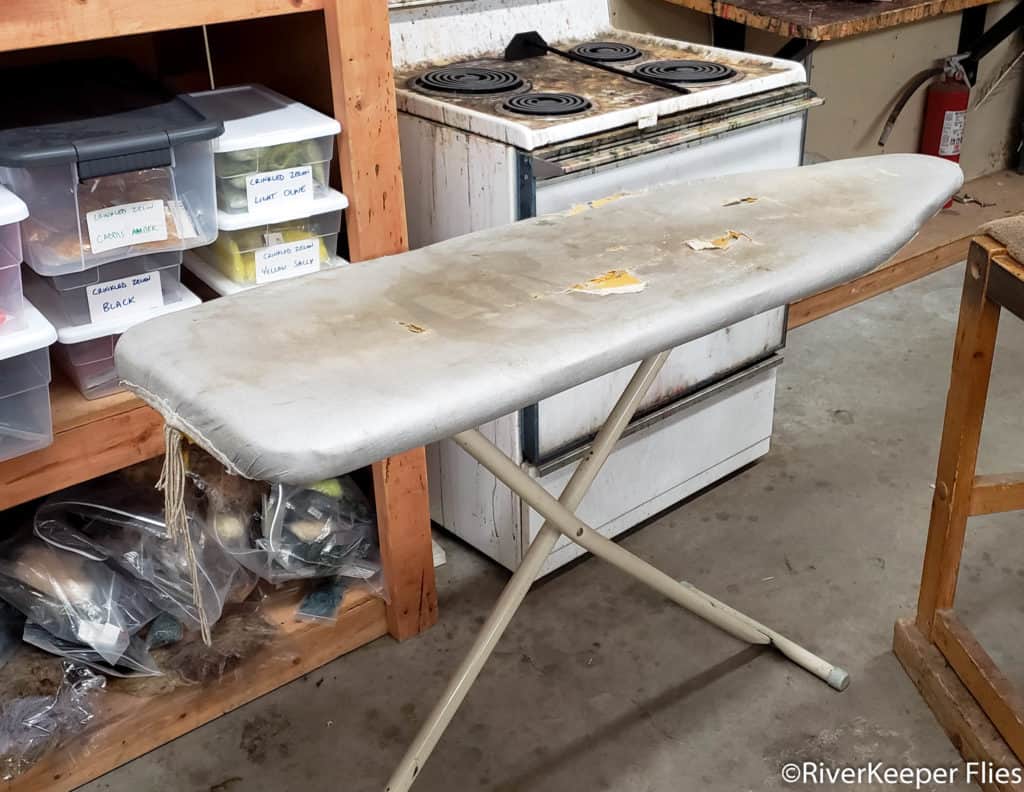
Ironing Board - www.johnkreft.com

This isn’t just any ironing board. It was the one used at Blue Ribbon Flies in West Yellowstone, MT to iron all the Zelon to make Straight Zelon.

Millie, the chief ironer, used this ironing board for many years to prep the Zelon. I’m guessing she filled hundreds and hundreds of bags which you found hanging in the shop for you to buy.

My wife and I were recently at Blue Ribbon Flies and Bucky took us to the area where they prep Zelon as well as dye all their Zelon, feathers, and hair.

I took a few pictures of several items, including the ironing board. You might have seen Craig Matthew’s fly tying chair last week.

I use Zelon in several fly tying patterns, like the Sparkle Dun and X Caddis. It happens to be their Crinkled Zelon. I’ve purchased Straight Zelon as well, but found I can stretch the Crinkled Zelon to make it a little straighter. But the problem is it doesn’t stay that way. Heat helps set the Zelon to stay straight, hence why the ironing board is important.

Enjoy…go fish!

Similar Posts

  • Dette Yellow Stonefly Nymph

    This week’s Throw Back Thursday Fly is the Dette Yellow Stonefly Nymph. I pulled out Mike Valla’s The Founding Flies and paged through to locate an interesting fly for this week’s post. The Dette Yellow Stonefly Nymph spoke to me. Walt and Winnie Dette are known for their beautiful Catskill dry flies. At least that’s…

  • Create Your First Fly Box

    Did you happen to read my post last week entitled Simply Identify Bugs Fish Eat? I explained the three basic insects you’ll find on the river, a caddis, mayfly, and stonefly. This week’s post takes the next step to help create your first fly box with flies to imitate these bugs. If you’ve fly fished…

  • Atherton No. 6 Dry Fly

    This week’s Throw Back Thursday Fly is the Atherton No. 6 dry fly. John Atherton (1900 – 1952) was an artist by trade and incorporated his impressionistic art into the flies he tied. Interestingly, he didn’t name the flies, choosing instead to number his dry flies from 1 to 7, representing lighter to darker shades…

  • Stewart’s Black Spider

    This week’s Throw Back Thursday Fly is Stewart’s Black Spider. Stewart’s Black Spider is from his book entitled The Practical Angler (1857). Copyright laws no longer apply and you can download the book by clicking HERE. Be sure to check out my Links to Free Old Fly Fishing and Fly Tying Books.

2 Comments

Leave a Reply

Your email address will not be published. Required fields are marked *