Last week I wrote about How to Choose Between Vests and Packs for Fly Fishing. The next logical question is how to carry a landing net? In fact, I received a couple comments about nets from that post. I’ll share some thoughts and practices that have or haven’t worked for me. Let me know if I missed something.
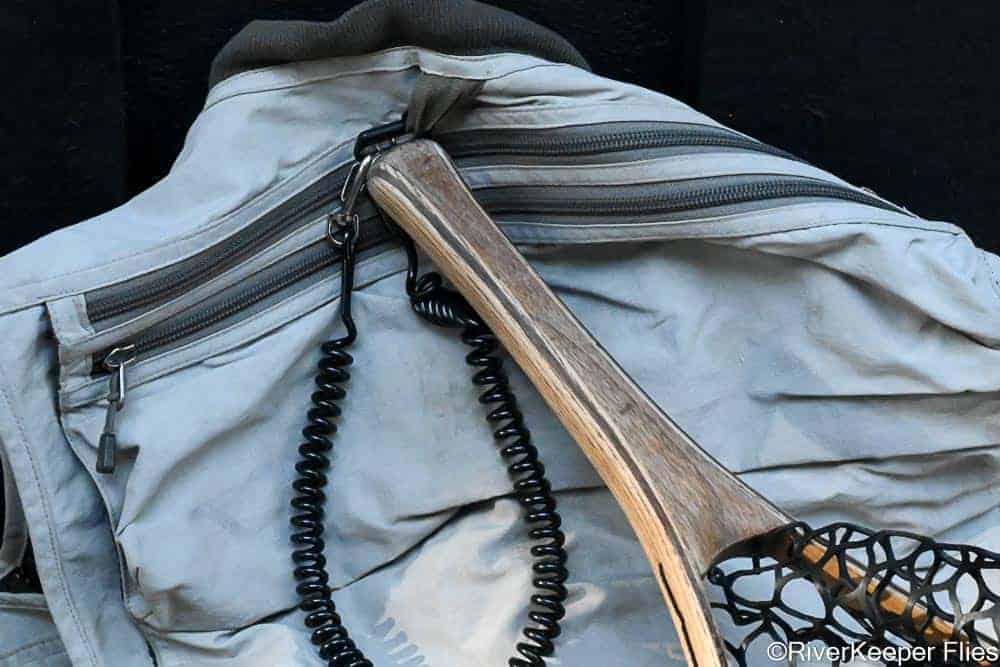
I’ll start with carrying a net on my vest.
This setup worked very well for me for many years when I wore a vest. It’s attached to the D-Ring on the back of the vest and stays out of the way. It’s within easy reach when landing a fish. To prevent me from losing the net, I use a magnetic net release on an elastic cord or lanyard. It allows me to release the net in moving water to focus on the fish during a photo opportunity and not worry about watching my net float downstream.
When I traded in my vest for a hip pack, I started by attaching the same magnetic net release to the shoulder strap. It worked fairly well, allowing the same hands-free operation mentioned above.

The biggest problem was the additional weight. Combined with the hip pack, I could feel pain in my shoulder where the strap layed. After a long day of fishing and multiple days on the water, I found myself always adjusting the strap to a different location over the shoulder and away from my neck. I’d seen other options available to carry a net and decided to try them.
The Smith Creek Holster was the next one I tried.
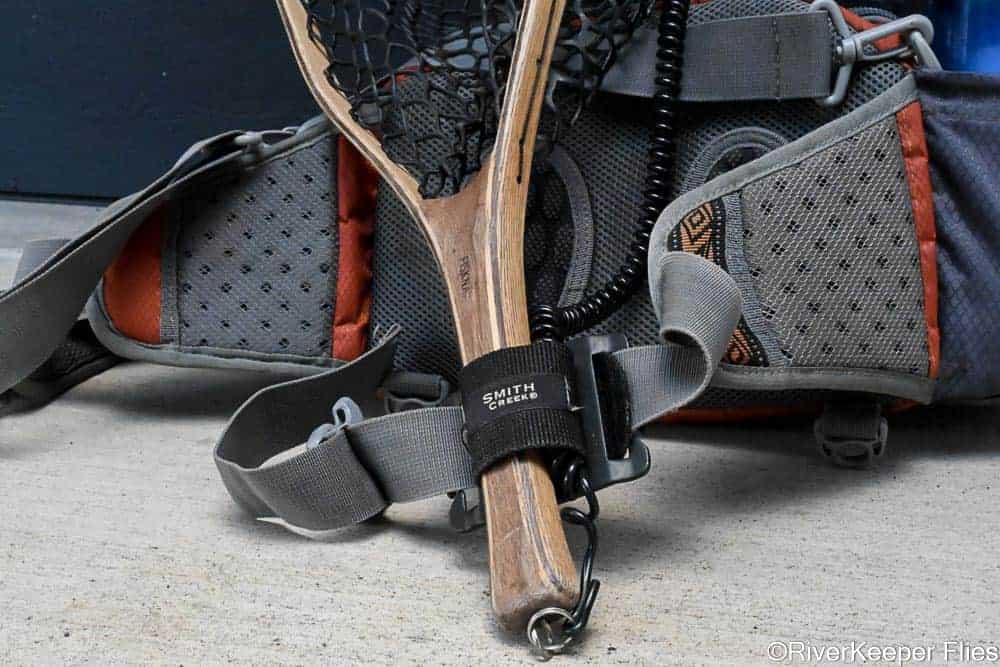
My goal was to remove it from my shoulder and attach it to my waist. The Smith Creek Holster fits on an existing belt of some sort. I used it on my hip pack and felt it was an improvement in removing excess weight over the shoulder. I could slide the holster around the belt so it would ride close to the middle of my back. I attached the same magnetic net release. The holster is made with an adjustable velcro strap to fit the handle of your net.
Let me pause a moment and demonstrate the two ways I know to attach a cord to your net.
I’ve always used an eye bolt screw that came with my nets and secured to the bottom of the handle. I had a similar magnet attached to the split ring that I’ve since removed.

The net on the right is how my wife attaches hers at the top of the net around the hoop. She’s used it that way for years as well.
There’s no right or wrong way to attach them. It’s whatever works for you.
The problem I had with the Smith Creek Holster was the way my strap, handle, and cord fit inside the adjustable strap/holster. It would catch when I removed the net from the holster to land a fish and on more than one occasion, the holster would pull away from my belt. I think if the cord was attached like my wife’s, it might have eliminated most of the problem. The other consideration is the net handle. Is it wide at the bottom and tapered? If so, you need to adjust the strap to account for the handle. Overall, it didn’t seem to work for me.
I purchased the next product from my friend Mike Avery at Snake River Nets. Besides wading belts, Mike creates beautiful hand-crafted wooden nets in assorted sizes. In fact, he just announced a new product – wooden rod cases. Be sure to check out his website!
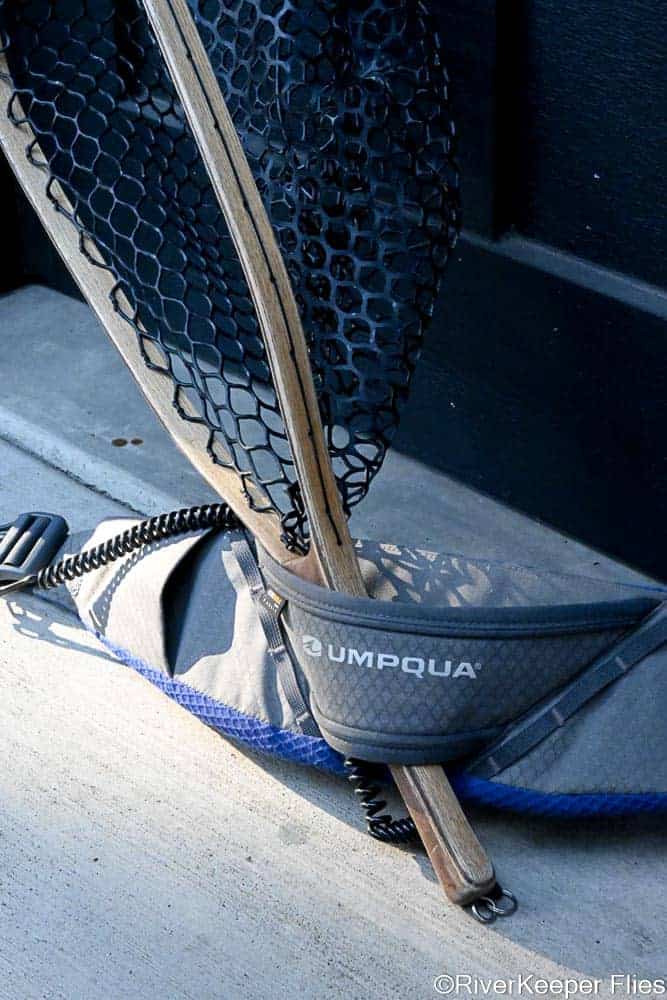
The Umpqua wading belt is what I’m currently using. I’ve used it over a year and really like it. The belt takes the place of my wading belt. There is a holster on the back of the wading belt where my net easily slides in and stays secure. It even holds a long-handled net when I choose to carry it. And yes, it does fit with my existing hip pack. I place the hip pack strap on top of the wading belt, so there is an extra one around my waist, but it seems to work fine.
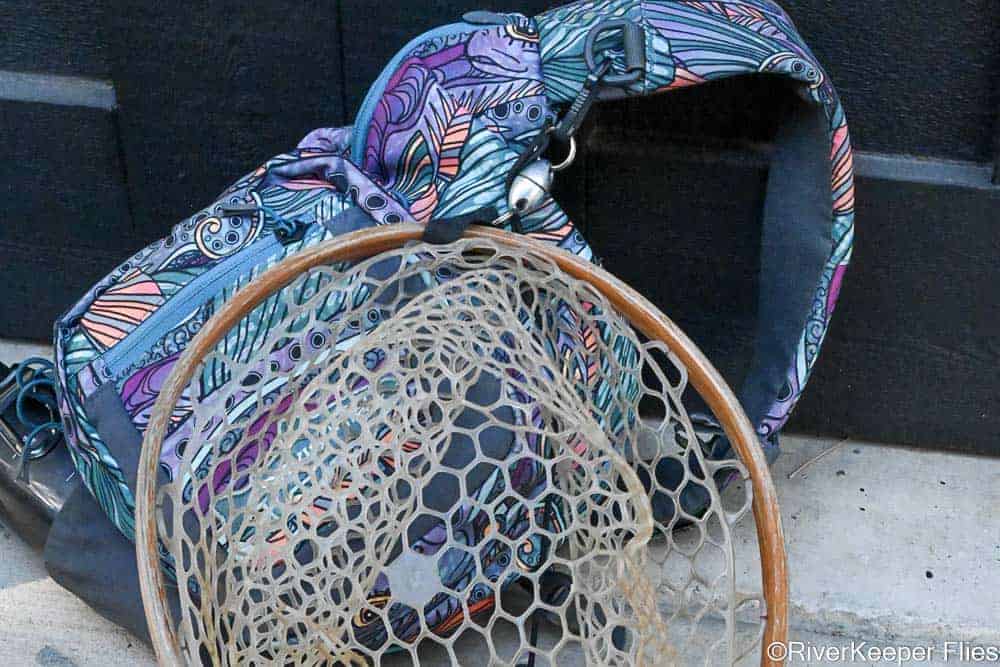
My wife attaches her net to the sling pack she uses to fish. You’ll notice, she too uses a magnetic net release and strap to hold her net. It seems to work for her.
If you have another method, be sure to leave a Comment below. I’m always learning!
Enjoy…go fish, stay safe!


Good article. Thanks for the information.
I attach the net to my sling pack D ring with the magnet release at the bottom of the net handle. It has worked for me and the net stays out of the way until needed. I thought about attaching the magnetic release on the net bag frame but decided I did not want anything protruding from the frame for line to snag on when netting a fish. The net bag doesn’t seem to get caught on brush as it hangs down. If my net had a deeper bag, perhaps mounting the magnet on the net bag frame may be the better option.
Great topic John.
For my net I use the magnet attachment approach as pictured in you post. I’ve bought additional matching magnet sets and mounted the “second half” to multiple gear packs and vests. For connecting the net handle I use a short nylon-cord lanyard and a stout “mini Gear Keeper” which has a large snap swivel clipped at my waist to a one-inch split ring or mini-carabiner.
Sounds complex but works well for me and gives considerable flexibility.
How do you attach the wadding staff? If you have the staff – one belt, and then the Umpqua belt and then the pack, that would be three belts. Does your staff attach to the Umpqua belt?
Rick
Thanks for leaving a Comment. When I do use a wading staff, I attach it to my Umpqua belt…next to the bear spray!
John