Got a question for you. When you’re fly fishing your favorite river, do you cast to a spot, cast as far as you can, or just let your fly land on the water anywhere and hope a fish will swim by and eat it?

I think you’ll have more success if you deliberately cast to a spot where you believe a fish is holding.
Here are a few tips to increase your fish-catching success. They work for me.
Observe
When you arrive at the river, stop and observe what’s going on. Try to resist the urge to begin casting immediately. And don’t jump into the water and start wading. Many times fish can be seen very close to shore. If you choose to wade, you might be walking through them.
Observe what’s going on. Can you see fish rising? At times, there may be a splashy rise, but not always. Sometimes the fish are sipping and only leave a small ring, barely perceptible. Those are the times I think the fish eats using a straw and sucking bugs through them! I saw fish doing that yesterday.
Any birds working over the water? That’s a sure sign either a hatch is going on or perhaps mayfly spinners are mating. There might be an upcoming spinner fall.
Read the Water
Can you locate the best holding water the fish might lie in? Look for underwater rocks or logs breaking up the current. It will be easier for a fish to hold there. Remember, fish always try to minimize their energy.
Watch the current. Look for a conveyor belt of bugs floating down the river. There surely will be a fish just waiting to eat a few of them. Perhaps you might see one of them.
Once I’ve picked out a likely lane I think a fish will lie in, I look at the currents and try to determine how the micro-currents will affect the drift. These micro-currents are NOT your friend. Many times these micro-currents will move your fly to a different spot or allow the fly to drag through the feeding zone. Neither of these outcomes is a good thing.
Now locate and cast to a spot upstream 5 to 10 feet where you think the fish is laying. Hopefully, all the stars align and your fly floats in the lane you’ve scoped out and the fish rises to take the fly.
Use a grid to search
If you don’t see any fish working, blind casting might work. Look for likely areas you think fish might be holding in and visually think about the best way to cover the water. I use a grid system. Start close and cast the fly out using a drag-free drift. Pull another foot or two of line off the reel and cast to the next area. Continue this technique and cover all the fishy looking water.
I use the techniques described above and it has made me a better and more accurate caster. In fact, I think it had a lot to do with winning the Pro classification at the 9-hole Casting Tournament at The Old Mill in Bend during the IFFF Fair!

I wrote an earlier post entitled Casting to Windows. Check it out for more tips on creating and extending drag-free drifts.
As you may have guessed by now, these are techniques I use when fishing dry flies. But they work just as well for the nymph flyfisher. If you see fish working, change to a dry fly. Otherwise, use the information I shared above; Observe, Read the Water, and Use a Grid to Search to determine where you’ll cast a nymph.
So the next time you’re at the river, cast with purpose as opposed to casting and hope a fish rises.
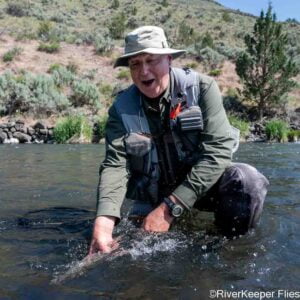
You might just catch one of these!


Well done…we need lots of this.
Thanks,
Sherry
John, good material. I will go into depth on this at my COF presentation on Oct on nymphing basics. Just got to US after 4 weeks on photo safari in Africa. Will miss your Sep. presentation due to my annual elk hunt. Bill
Bill
Thanks for the nice comment. Just trying to help out…
John