This week’s Throw Back Thursday Fly is a Gordon Quill fly package.

This is a package of flies a friend recently gave me because he knew of my love for fly fishing and tying history.
He told me they were at least 100 years old!
Needless to say, I was shocked at his generous gift.
Perhaps because I live on the west coast, I had never heard of William Mills & Son, so I did a little Internet search on the name. They were founded in 1822 as T. & J. Bate. The company was renamed several times with various versions of Bate, but was changed to William Mills & Son in 1875.
I found a copy of their 1909 catalog page 62 and a dozen of these “Special Stream” flies cost $1.00. The Gordon Quill fly package were offered in size 8, 10, 12, 14, and 16.
The flies are tied with “extremely thin round gut, much lighter weight than usually used.”
Here is a close-up of the flies.
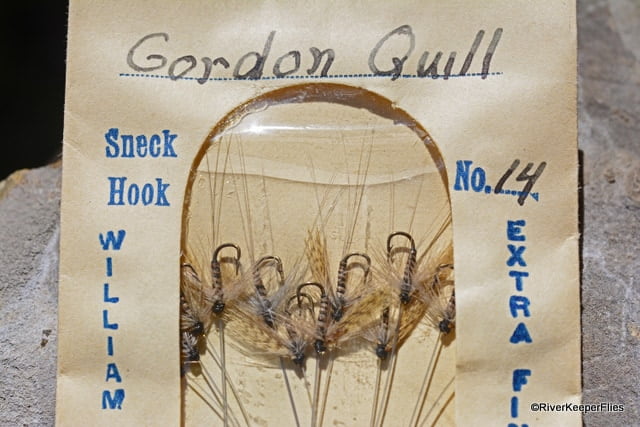
Notice how some of the hooks appear almost square? I’d like to examine them closer, but I’m afraid to take them out of the package.
I highlighted the Quill Gordon fly in an earlier Throw Back Thursday Fly post, but thought this package of hooks needed it’s own post. I hope you like it as much as I do. Did you notice how the name is changed? I’ve never heard it called the Gordon Quill, so I wonder if is was a mix-up. The Quill Gordon was created by Theodore Gordon sometime before 1906. Gordon has been recognized as the father of American fly fishing.
Here is a little history from a website (www.luresnreels.com) I found from an Internet search on William Mills & Sons. The following is used with permission.
“William Mills & Son was one of the longest run sporting goods stores in the USA. The company William Mills & Son was established in 1822 under the name T. & J. Bate. The company name changed to Thos. Bate in 1836, to T. & T. H. Bate in 1843, to Thos. H. Bate in 1853 and then to T. H. Bate & Co. in 1859. The name was finally changed to Wm. Mills & Son in 1875. Probably the most famous brand reels sold by Wm. Mills were those by H.L. Leonard. Hiram Leonard was a famous rod maker from Bangor, Maine. In 1877, Francis Philbrook assigned his patented raised pillar reel to him and that was the start of the Leonard reel history. The earliest models have beautiful marbleized orange and black hard rubber end plates and handle knobs and are marked Philbrook & Paine, Makers. Marbleized fly reels and salmon reels have also been found unmarked and marked William Mills & Son. The next series were bimetallic and had nickel silver frame with bronze rims and pillar attachment tabs. The first bimetallic fly reels had nickel silver spools and later ones had aluminum ones. Either of these reels is considered rare and highly collectable. Most Leonard reels found are the later ones sold by William Mills & Son and are marked “H.L. Leonard, Patented” or “Leonard-Mills.” The Leonard-Mills reels were made for the William Mills Co. by Julius vom Hofe starting around 1900 up until World War II. All the Leonard reels are high quality and sought after by collectors. Reels marked Philbrook & Paine or T. H. Bate are also highly collectable.
William Mills also offered reels made specifically for them. They were made by Geo. Gayle & Son and were named “INTRINSIC.” One was a high quality bait casting reel of German silver with an aluminum spool. It came in two variations and in No. 2 and No. 3 sizes. One version had a flanged head plate and the other was a standard Kentucky style reel. Gayle also made a 9/0 size reel made of German silver with hard rubber end plates.”
Lastly, if you are interested in a little history, here is a link to the 1909 version of the William Mills & Son catalog. I hope you enjoy reading it as much as I did.
William Mills & Son 1909 Catalog
This catalog has been digitized by Google Books and the copyright has expired, so it is now in the public domain. This copy was from Harvard University.
Enjoy…go fish!



That catalog is wonderful! What an education just to go thru it.