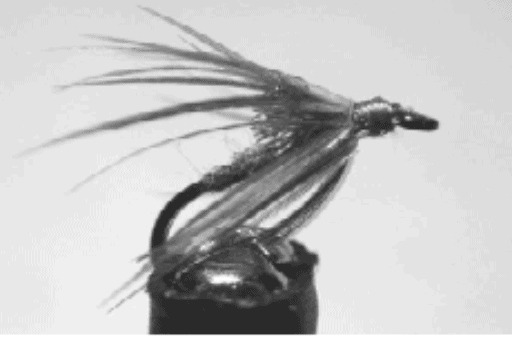
This week’s Throw Back Thursday Fly is Pritt’s Greentail.

This soft hackle fly is another old fly pattern found in T.E. Pritt’s Yorkshire Trout Flies (1885) book. It’s listed as No. 33 on page 32. The second edition changed the title to North Country Flies (1886) to be more inclusive.
Materials
| Wings | Hackled from a feather from the inside of a Woodcock’s wing, or from a Partridge’s neck, or from under a hen Pheasant Wing. |
| Body | Lead coloured silk, twisted with a little fur from a hare’s face. |
| Tail | Green silk, wrapped over lower part of body. |
I used brown Pearsall’s silk thread for the body on this #14 hook.
One of the fly tyer’s I admire is Davy McPhail. Here is a link to his Youtube channel where he ties the fly.
Enjoy…go fish!



Can you tell me the full name of T E Pritt? All I can find, no matter where I look, are the initials T & E.
LA –
Thanks for leaving a Comment. Thomas Evan Pritt
I found the answer in Robert Smith’s The North Country Fly book.
John
John… I’ve been working on wets for a couple months,,,trying to learn the techniques and materials from the old recipes. I’ve asked some other tyers what benefit is derived from using silk, other than it was used traditionally, over thread. Wonder what is your opinion? I’ve found it problematic to use silk on the smaller flies, especially trying to keep the heads small. I’ve experimented with various silks, as Pearsal’s is expensive and finding the right colors is hard. Do you have any suggestions?
Ron
Thanks for your comment. You are absolutely correct about using silk thread for smaller flies. They build bulk quickly. There is something aesthetically pleasing using silk thread for the older flies. I think to some extent, it connects us to the past. Most of the time, I think you could substitute any thread for tying soft hackle flies. However, silk thread does have a luster to it and might be better when using purple or orange. I’ve read Japanese YLI brand silk 100 thread is very close to the original Pearsall’s silk. Joann’s carries it in 220 yd spools for $6 – 7 bucks. I’ve looked at these before and the only problem is it’s online only and I’m not certain about matching colors.
Hope that helps.
John