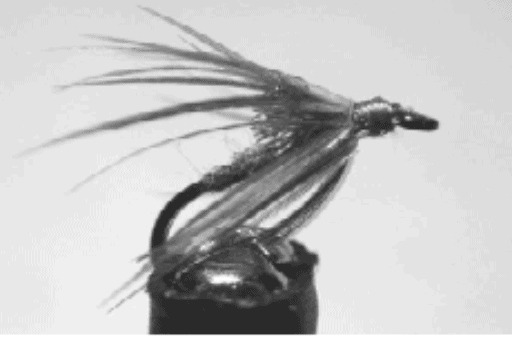
This week’s Throw Back Thursday Fly is Ray Bergman’s Dr Burke.

I’ve had this fly on my list to tie for quite some time. I just like the elegance and simplicity of a Bergman wet fly and it forces me to practice mounting duck quill wings whenever I feature one of Bergman’s flies.
You can find the Dr Burke wet fly on Plate No. 3, page 48 of Bergman’s Trout (1940 – fourth printing).
If you check on the title page of Trout, you’ll find the citation as follows:
Fly Plates in Full Color Painted by
Dr. Edgar Burke
The following information is quoted from Harold Hinsdill Smedley’s book entitled Fly Patterns and Their Origins (1944).
This fancy fly, of silver body, yellow hackle and a white wing with jungle cock, is named for Dr. Edgar Burke, of the Jersey City Medical Center, in Jersey City, N.J. Dr. Burke is the author of a brochure entitled “American Dry Flies and How to Tie Them.” His paintings of flies are recognized everywhere as the finest and most beautiful. A most complete set is found in Ray Bergman’s book, “Trout.”
The Doctor says:
“It seems to me to be true that the better the angler the more he appreciates the brown trout. Brook trout are the fish for the casual fisherman ; the brown trout is for the expert angler.” Concerning flies the Doctor has stated: “Indeed but two, the wet Quill Gordon for the first two weeks of the season and the dry Hendrickson for the rest of it.”
His fly “was a deliberately ‘studied out’ creation intended for dusk fishing in the Kennebago watershed in extreme Northwestern Maine. It is composed of elements that will retain their flash and glitter as long as there is a vestige of light in the sky.”
For more Ray Bergman flies, just click Ray Bergman Flies under the Category section on the right of every page.
If you are interested in more old books to download and read, be sure to check out my Links to Free Old Fly Fishing & Fly Tying Books.
The Dr Burke
Body
Flat Silver Tinsel
Ribbing
Silver Tinsel
Tail
Peacock Sword
Hackle
Yellow
Wing
White – also Jungle Cock Eye
Note: tied on TMC 3906 #10 hook
Enjoy…go fish!



Dr. Burke was my Great Uncle but I was never a good angler. RIP Edgar Burke.
Nice work. I appreciate the color combinations. Should be especially effective when salmon smolt are out-migrating.
Beautiful!!!