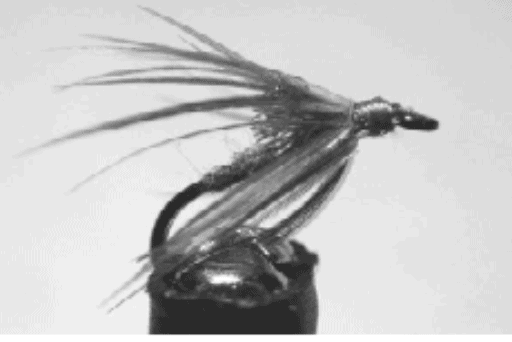
This week’s Throw Back Thursday Fly is the Bostwick, one of the wet flies Ray Bergman cataloged in his book entitled Trout, first published in 1938.

The Bostwick is from Plate No. 1 and one of only a few flies where the hackle was palmered through the body.
Bostwick on Wood Duck

How did I choose this particular fly? Well, my wife’s grandfather’s last name was Bostwick and I thought it was very appropriate. Jim is gone now, but whenever I saw him he always asked “How’s fishin’?” It makes me smile just thinking of him.
In his Introduction, Bergman wrote this book was “…written from the heart as well as the brain; drawing from thirty-five years of experience gained in water from coast to coast. I have written it as if it were addressed directly to a dear friend who had stopped in to see me and to ask for information.”
Bergman’s book includes 15 colored plates to illustrate the dry and wet flies with a description of each fly in the back. It was the first book to provide color fly illustrations.
I’m not an expert about Ray Bergman, but I look to Don Bastian Wet Flies website whenever I need information or clarification. Don is a well known fly tyer, author, and speaker and has recreated the fly plates found in Trout. His flies are works of art! One of Bastian’s post entitled Ray Bergman – Some Clarification and Edification will provide additional history about Ray Bergman, if you are so inclined to learn more.
Here is the fly pattern recipe from the Full Description of Flies Shown in Color Plates in the final pages of Trout. The materials order is as listed in the book:
Bostwick
Body:
Silver tinsel
Tail:
Barred Mandarin
Hackle:
Mixed Brown & Griz Tied Palmer
Note: I have substituted Wood Duck for the Barred Mandarin. The fly is tied on an older Mustad 3906 hook.
Enjoy…go fish!


Hi John,
That is a great looking fly. Take care & …
Tight Lines – (Gretchen &) Al Beatty
Al
Thanks for your comment. I’ve always thought there was something elegant about Wood Duck feathers. I really enjoy tying a fly with them.
John