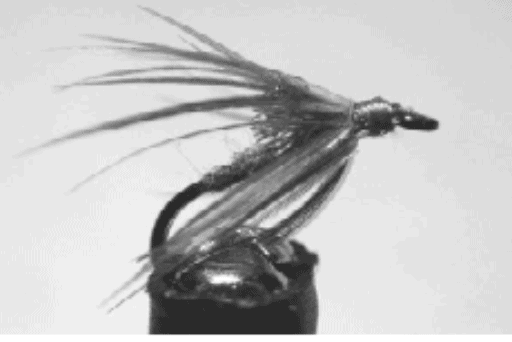
Do you know the names of all the bugs you see on the river or lake? Do you need to know these names to catch fish? Not at all. Fly fishers have developed their own common names over the years for many bugs in order to share information about recent fishing trips. I have to say that I can identify a lot of bugs, but there are some confusing mayfly names that even I have difficulty with.

When I explain bugs to beginning fly fishers, I start with basic information about the three major bugs important to their fishing success. Stoneflies have wings flat along the top of their body. Caddisflies have a tent-shaped wing. Lastly, mayflies have upright wings which look like sailboats floating in the water. Knowing this basic information is a start for sharing with other fly fishers.
What was most confusing to me when I started fly fishing were the names of mayflies. I didn’t realize many bugs I saw on the river were really named for flies developed many years ago to imitate them.
Blue Wing Olives (BWO) and Pale Morning Duns (PMD) are two prime examples.
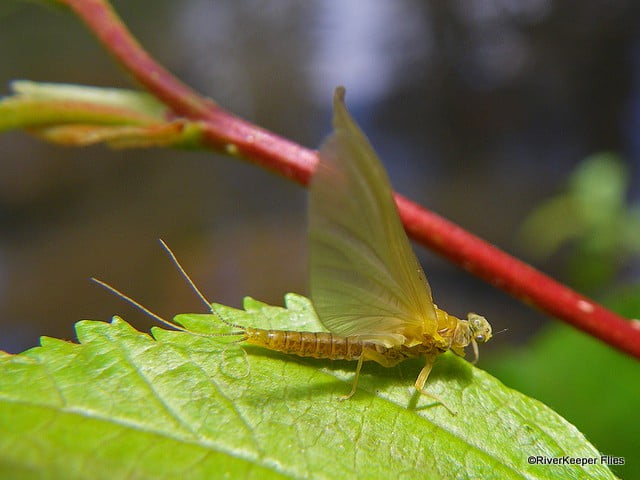
Let me begin with the BWO. These bugs are really known as Baetis. Some fly tyer developed an artificial fly many years ago to imitate one of the Baetis they saw along the river that happened to have a bluish cast wing and olive body, hence the name Blue Wing Olive. But many Baetis don’t have those colors. Wings could be various shades of gray or “dun” and the body color of olive, gray, or even what I call a non-descript brown.
Here is a perfect example of what most fly fishers encounter for a BWO.


How about PMDs? Perhaps they were named for a bug that hatched in the morning that was a light colored, medium sized mayfly. Were they still called the same name if they hatched in the early afternoon? Many bugs might fit this description.

These are only two examples of the confusion fly fishers find when trying to describe the bug they encountered on the river.
You’ll encounter the same issue when talking about March Browns and Green Drakes.
Many fly fishers try to be more specific to identify bugs and end up using the Latin names from the taxonomic level, which include Phylum, Class, Order, Family, Genus, and Species. I guess I’m one of them.
Let’s break it down in more detail.
Phylum and Class will be the same for all of our bugs:
Phylum: Animal
Class: Insecta
The major Order for our bugs found in rivers are Ephemeroptera (Mayflies), Plecoptera (Stoneflies), Trichoptera (Caddisflies), and Dipters (Midges).
See how easy that was? We’re already half-way through!
So back to my two examples, let’s start with the Family Baetidae and Genus Baetis or what some fly fishers call BWO. There are 26 Western Species. They have 2 tails, wings pale gray to dark slate gray, body color pale to dark olive, brown, or gray. Bodies are 1/8 to 3/8 inches in length. Usually, that’s as far as the fly fisher will go. There is no need for going down to the Species level. All you need to do is find an fly imitation matching size and color and fish it.
PMDs would be the Family Ephemerellidae and Genus Ephemerella and include 12 different Western Species. They have 3 tails, wings of pale yellowish-gray to pale gray, and sometimes with yellowish mottling or tint, a body pale to bright olive-yellow. The underside of the body is usually lighter in color. Size 1/4 to 1/2 inch (E. inermis) and 3/8 to 5/8 inch (E. infrequens). The inermis and infrequens is the Species level. Notice the only difference between them is size.
Understanding a little about aquatic entomology will help identify whether the nymphs are swimmers, crawlers, or clingers. This information provides input to determine an appropriate nymph imitation and prepares you for which mayfly imitation to have ready in your fly box.
To learn more about the habits, likely hatch times, and imitations to match these mayflies, I like the books Western Mayfly Hatches by Rick Hafele and Dave Hughes and BugWater by Arlen Thomason.
My spring creek has a vast diversity of mayflies, which is why I’m interested in identifying them. Here’s an example of what I’m talking about:

Here are a few mayfly names I get mixed up at times. The Genus level is needed to help ID these bugs.
Serratella (#14 – 16) – This is the Genus level. There are 7 Western Species. The duns have 3 tails, wings of gray to dark gray, bodies of brownish-olive to dark reddish-brown, legs cream color and range in size from 5/16 to 3/8 inches for length of body.
Ameletus (#12 – 14) – This is the Genus level. There are 26 Western Species. The duns have 2 tails with body color brown, yellowish-brown, or pale olive and are body length of 1/2 inch, excluding tails.
Cinygmula (#12 – 14) – This is the Genus level. There are 10 Western Species. The duns have 2 tails and their wings are gray or amber, body color pale cream to olive, orange, red or grayish brown. Body length from 5/16 to 1/2 inches.
Flavilinea (#12 – 14) – This is the Species level of Genus Drunella. There are 6 Western Species. The duns have 3 tails, wings pale to dark gray, and body color dark olive to brown and lack distinct segmentation by bright banding. Body length from 1/4 to 5/8 inches.
Caudatella (#12 – 14) – This is the Genus level. There are 7 Western Species. The duns have 3 tails with outer 2 tails shorter than center tail, body 3/8 to 1/2 inch in length.
I hope you’ve learned something and I’ve eliminated some of the mystery about how confusing mayfly names can be. I’ve said it many times before that to be a successful fly fisher, just concentrate on the size, profile, and color in that order.
I need to go to the river and look for a few Cinygmula mayflies.
Enjoy…go fish!


Thank you for your informed website and posts; one minor correction: Phylum for insects is arthropoda; they share with spiders (arachnida), centipedes (chilopda), millipedes (diplopoda), and crafts and crabs (Crustacea).
Thanks for the Comment Bob. I’ll check my original source to see what I did wrong!
John
Awesome Info