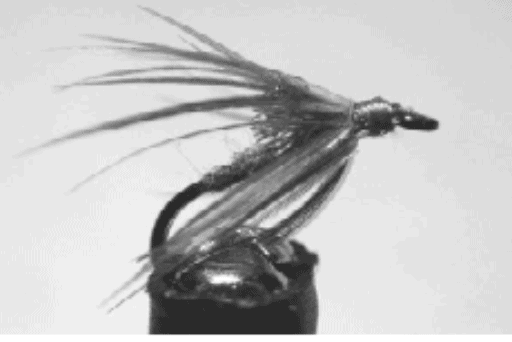
This week’s Throw Back Thursday Fly is the Beetle Bug Coachman.

I was asked by a friend recently to tie up a few of these flies for his local river. It’s an old fly pattern he had seen recently on my RiverKeeper Flies website. Turns out, it was on the cover of this book, John Shewey’s Favorite Flies for Oregon (2021)


Here is a closeup of the fly.

Shewey writes that John Dose, a well-known fly tyer from the Eugene, OR area, created the fly in the 1920s. The fly was tied in a hair-wing style. Later, Bob Bordon created a variation you see above. While he utilized calf body hair for the wing, I’ve tied the fly with calf tail. Some of you may recognize the Borden name as he is the one who started the wholesale Hareline Dubbin company.
His original Beetle Bug Coachman were tied with bucktail for the tail and wings.
He further writes that Audrey Joy popularized the fly as she tied many of them on her treadle-style vise in the sporting goods department at Meier & Frank in Portland, OR. She was a staple in the store for over twenty years spanning portions of the 1940s through 1960s.
The following image shows the Beetle Bug Palmer, a variation from Oregonian Dave Hughes where he created a better floating fly.

You can read more about the fly in John’s book.
Enjoy…go fish!




-Interesting dtuff, and thanks, John, for the ongoing history lessons with these old patterns.
Bruce, I’m not familiar with Congo Hair. Is it UV reflective? Calf tail is – and so are the wings of mayflies. Over the years I’ve had better luck with calf tail wings than I should have, and recently learned why. I like calf tail’s stiff and krinkly fibers for their silhouette and ease of tying, once stacked. They hold their shape and seldom give in to fewer than about forty fish.
As to stacking, I abandoned conventional stackers years ago in favor of glass test tubes in various sizes. Drop the hair in the tube butts first, cover the opening with your thumb, hold the tube between your index and middle finger like a cigar, invert and shake the tips against your thumb. The tips stack up in no time. Easy-peasy.
The palmered version of the fly reminds me of the Kolzer series that Dan Bailey sold for years in red, yellow, and orange variations. Those flies had elk or deer wings and tails. I think I like the calf tail wings better. The Kolzers floated and danced on the Madison and other rough-riffled rivers
You seldom see them now, and I wish I had saved some that were tied by the women in Dan Bailey’s shop before the change was made to all-import flies. The shop I bought when I first came to Montana had dozens of them in the bins. I could always get more – until I couldn’t. As things change in this sport, you never know when history is slipping through your hands.
I still have random packages of Bordon Hareline dubbings. I find calf tail hair fine for streamers and wet flies but find using synthetic materials such as Congo Hair, as a substitute winging material aid greatly in helping a dry pattern remain on the surface. Most tail hair is to dense for effective use in dry patterns