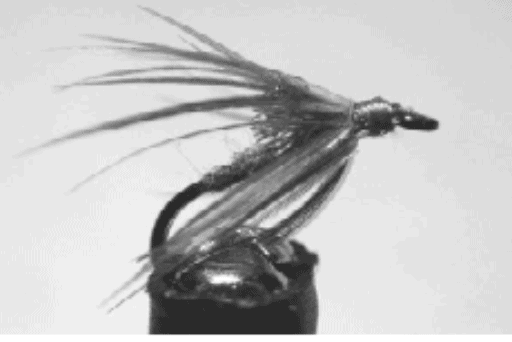
This week’s Throw Back Thursday Fly is Lindgren’s Peacock.
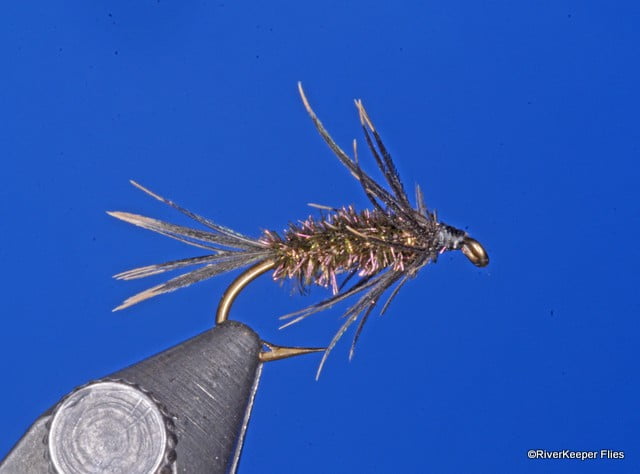
This fly was developed by Ira Lindgren. The first TBT fly I posted from Ira was the Lingrens Olive. However, I’ve since learned the name was misspelled in the book I used as a reference.
I tied this simple fly on a #10 Mustad 3906 hook and substituted Starling for the tail and hackle.
My friend Wayne Luallen, a superb fly tyer in his own right and recognized as the 1991 Buz Buszek Memorial Fly Tying Award recipient, provided the following information about Ira:
“Ira Lindgren was a grape farmer living in Dinuba, CA. He was far ahead of his time among fly fishers.
In the 1950’s he snorkeled the Kings River observing how fish fed and wrote several articles about his observations and fly fishing in general. I recall his writing about how trout were constantly picking up anything drifting by – twigs, debris, or insects – that might possibly represent food, but he was especially impressed how quickly they could reject that object. (Some of his articles may still be available thru the Fresno Fly Fishers for Conservation club in Fresno, CA, or the Kaweah Fly Fishers club in Visalia, CA which have reprinted some in their newsletters over the years.)
He was a friend of Wayne ‘Buz’ Buszek in Visalia and Doug Prince who lived in Monterey who with Buz and Ira fished the Kings River often. Ira had access to peccary and used the body hairs natural or dyed to make the “quill” body on his dry flies. Typically they were tied with a hackle barb tail, a single peccary hair wound for the body, and an over-sized (for the hook used) hackle with no wing. His nymphs were very simply tied, but very effective, generally employing peacock herl. Buz’s Fly and Tackle in Visalia for many years sold some of Ira’s patterns, particularly his nymphs. Perhaps his most effective was his most simple: Lindgren’s Peacock.
Hook: Mustad 7957BX or 3906, size 10-14
Thread: Black Nymo
Tail: sparse dyed black hackle barbs
Body: Peacock herl counter-ribbed with gold wire
Hackle: dyed black hackle trimmed top and bottom leaving just a few barbs to either side
Regrettably Ira ended his life in 1966, a year after Buz chose to do the same.”
Thanks for the information about Ira, Wayne!
Enjoy…go fish!




Amazingly, I just accidentally ran across this. I ran an internet search for Lindgren’s Peacock. Was one of my favorite flies back in the seventies. Many decades with little or no fly fishing have passed. Recently picked it up again. I still have much of the materials I had in the seventies. Fishing the Merced River a couple weeks ago, I had tremendous success with this little nymph. The old patterns are often still great.
I worked at Buz’s Fly Shop for a short time. Great times.
Thanks for leaving a Comment Lance and happy to hear you returned to the vise! The old patterns still work. I love the “simple but effective flies”.
John