This week’s Throw Back Thursday post is the Dette Hackle Guide.

You’ll note there are two color…a black and lighter color guide. These work well regardless of the color hackle the tyer is measuring.
You might ask how I arrived at the Dette Hackle Guide as the subject of today’s post.
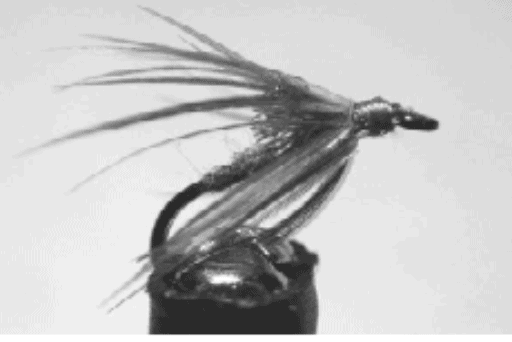
Well, I selected a fly to highlight and pulled out all the materials and tied the fly. It was a Spruce Creek Dry Fly that George Harvey had tied. Here is my version.

I thought it turned out pretty well and sat down to write a few words about Harvey and the fly. Turns out, I featured this fly back in 2022…not that long ago.
I won’t say anymore about it, but encourage you to click the link if you are interested – Harvey’s Spruce Creek Dry Fly.
This being a Catskill style fly, I decided to pull out the Dette Hackle Guide when I tied the fly and thought it might be of interest to you, so I quickly took a couple pictures and here it is.

The image above shows the hackle guide in Eric Leiser’s book about Walt and Winnie Dette and their daughter Mary Dette Clark entitled The Dettes – A Catskill Legend (1992).
The proportions on many Catskill fly patterns are different than I use to tie my flies. I find this Dette Hackle Guide is pretty accurate if I were to tie a standard dry fly. In fact, I used it to tie the Spruce Creek Dry Fly above.

I pulled out a size 14 hook and the mark is 1 1/2 times the gape of the hook. The paper guide included provides proportions for three different styles of flies.
Lastly, I’ll share what I wrote in one of the TBT posts about the Dettes:
The Dettes sold their flies from home in Roscoe, NY. I believe their house and vises were at the epicenter of fly tying and were known as “the world’s leading dry-fly-tying experts.”
Here is a link to the Dette Fly Shop along with a little more information about them from their website:
Established in 1928, Dette Trout Flies is the oldest family run fly shop in the world, now in our 95th year. Our mission has always been, and always will be, to supply the fly fishing community with the finest products and service. Every fly we sell is either tied in house or by a handful of select domestic tiers.
In Spring 2018 to commemorate 90 years in business we have opened a larger location in Livingston Manor with the goal to provide a welcoming space to display our ever growing selection of flies, fly tying materials, and fly fishing gear. Our inventory is solely comprised only of products that meet our demand for high quality standards. The Roscoe store is closed.
Lastly, I’ve included an Amazon link to book. If you get a chance to buy it, you won’t be disappointed.

Enjoy…go fish!
(John Kreft is a participant in the Amazon Services LLC Associates Program, an affiliate advertising program designed to provide a means for sites to earn advertising fees by advertising and linking to amazon.com.)


Hi John,
Thanks for a great post. We still use our Dette Hackle Guide today. Take care & …
Tight Lines – (Gretchen &) Al Beatty