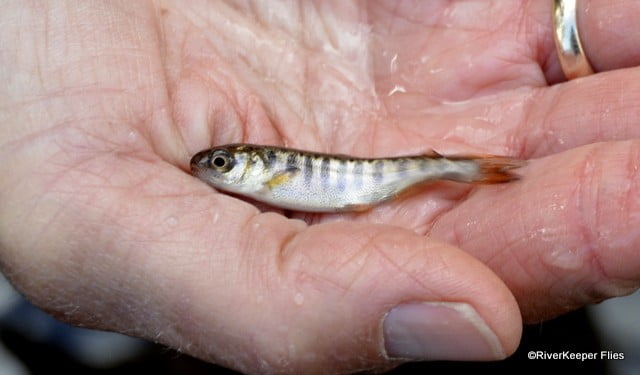
Today was a good day. We planted 140,000 Spring Chinook salmon fry in the mainstem of the Metolius River.
Ok, truth be known, we probably had a little help…actually, we were only 2 of around 20 volunteers and staff from Oregon’s Fish & Wildlife, Forest Service, and the Warm Springs Tribe who met at Camp Sherman with a tank full of fish from the Warm Springs hatchery.
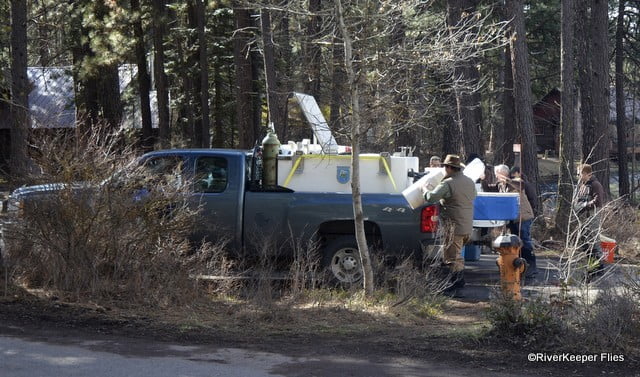
It’s part of an ongoing, multi-year effort to reintroduce Spring Chinook into the Metolius River. Three years ago, we trudged through the snow to plant fly in the upper reaches of Lake Creek.
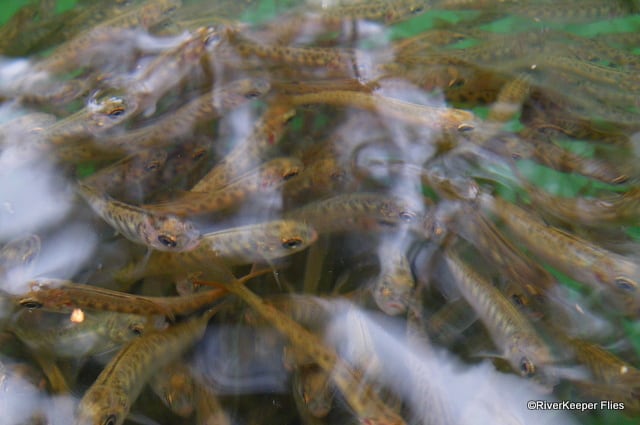
They seemed happy…what do you think?
These fish are planted up and down the river as well as the feeder creeks. We looked for softer water to plant these little guys. This is my friend Gary helping out too.

First, the salmon fry are placed into thick plastic bags with a mixture of water from the hatchery and the river. A little oxygen is added to help increase the fish survival rate.

Then, the salmon fry acclimate to the river water. There are around 2,500 fly in the bucket.

Lastly, we let a few out at a time…oops…perhaps we slipped here.

I’m sure the fish were a little shell-shocked finding themselves in a big river. A few took off across the water. Most settled to the bottom of the river.

These fish are part of the 2015 brood that will travel down to Lake Billy Chinook, the Lower Deschutes River, the Columbia River, all the way to the ocean. They’ll spend a few years in the ocean and hopefully return in 2019.
Historically, Spring Chinook and Sockeye Salmon called the Metolius River home. I’ve been fishing the river over 45 years and I never saw any salmon in the river.
The Pelton and Round Butte dams were built in the 1960s and blocked the natural route back to the Crooked, Deschutes, and Metolius rivers for salmon and steelhead. Hatcheries were created to take up the slack. However, these little guys had a difficult time swimming around Lake Billy Chinook and finding an outlet to the Lower Deschutes River.
A salmon and steelhead reintroduction project was part of the relicensing requirement of Pelton Round Butte Hydro Project. The $100 million water mixing and fish passage tower was created to help flow within Lake Billy Chinook in an attempt to get these young fish in traps and around the dams. It became operational in 2010.
Results so far are a little slow. I’ve heard only 50 – 60 adult fish returned to the Round Butte Dam Complex last year.
We hope to see a small percentage of these fish in 2019.
And at the end of volunteering for the day, we did…

Enjoy…go fish!