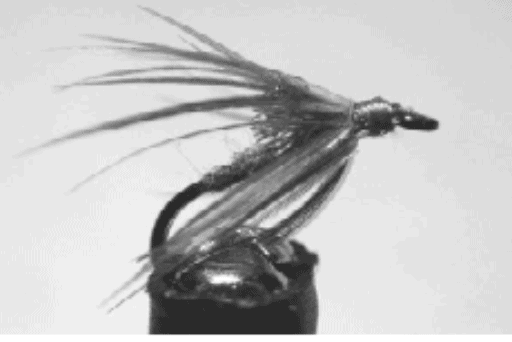
This week’s Throw Back Thursday Fly is Frank Sawyer’s Pheasant Tail Nymph.
 Sawyer’s Pheasant Tail Nymph Size 16
The original fly was tied with just two materials, pheasant tail fibers and copper wire.
Englishman Frank Sawyer was known as a riverkeeper for a six and one half mile section on the River Avon in Wiltshire beginning in 1925. A short time later, he worked for the Services Dry Fly Association, a club of active duty British military officers and ex-serving Ministry of Defence personnel. It was a position he held until 1980.
Sawyer designed his Pheasant Tail Nymph to imitate a swimming Baetis nymph with it’s legs tucked close to the abdomen, thus there are no legs on the fly.
In his book Nymphs and the Trout (1958, 1973), Sawyer provides tying instructions as follows:
“First grip the selected hook firmly in the vice and then give the hook an even covering from bend to eye with fine red-coloured copper wire. The wire we use is little thicker than a human hair and this one can obtain at little cost from various sources. It is used for the windings in small transformers, dynamos, or electric motors. After the hook has been covered and the wire locked so that it cannot spin around the hook shank, wind the wire in even turns to the point where the thorax of the nymph is to be constructed, and there build up a hump. Then wind the wire back to the hook bend and let it dangle. Wire is much easier to use than silk as it will not spin off or loosen if the tension is relaxed. The wire with its red colour forms the base for the dressing and at the same time gives additional weight to the hook. I dispense entirely with the use of silk and use the fine wire to tie in the dressing. The wire is now dangling from the hook bend. Take four centre fibers of a browny-red cock pheasant tail feather. Hold the fibres by their tips and then tie them on with the wire so that the fine ends stand out about one eighth of an inch from the hook bend. They form the tails, or setae of the nymph. Then spin the four fibres of the pheasant tail on to the wire so that they are reinforced, and then lap fibres and wire evenly to the hook eye. Hold the wire firmly, separate the fibres from it and then wind the wire to the point behind which the thorax is to be made. Bend the fibres back and fasten for the first lap of the thorax, then forward to the eye of the hook again. Fasten here securely with half a dozen turns of wire and then cut away spare fibres.”
Our finished effort should have a very pronounced thorax which suggests the bulging wing cases, and a body which tapers neatly to the tail. With the tail fibres spread, all is complete.
It will be noted by those who follow these instructions that the upper part of the thorax which imitates the wing cases, is much darker than the rest of the body. This is brought about by the lapping back and forth of the butt ends of the pheasant tail fibres. If wire and fibres are wound evenly on the hook, the spare ends should have the dark tone which is a feature in the butts of these fibres. This gives a very natural appearance to the thorax. The fibres of pheasant tail vary in length, and indeed texture, from the butt of the feather to the tip, so when dressing a nymph one can select lengths most suitable for the size of the hook, bearing in mind that when the body is made, the dark part is ready to use for lapping.
When wet this pattern has a translucent effect and one can see the red of the wire showing through the pheasant tail fibres. The artificial, so constructed, has a very good entry to water and will sink deeply when required. The hook point is not muffled or guarded in any way by hackles or by the dressing, and a slight lift of the rod will drive it home.”
You can read this book free on Internet Archieve. Just sign up for free access to read the book. Unfortinately, one can only borrow the book for an hour at a time and not download in its entirety to read at your leisure. You can find links to other older books on my Links to Free Old Fly Fishing & Fly Tying Books page.
Many fly tyer’s have come up with different methods of tying the fly. Here is Davy McPhail’s version which is close to Frank’s original.
Steve Schalla writes on his excellent Fly Fishing the Sierra website about variations from the original.
The first variation, and perhaps the best known was Al Troth’s American version which included a peacock thorax and pheasant tail legs.
 American Pheasant Tail Nymph
Here is a link to Tim Flagler’s Tightline Productions where he demonstrates the fly.
Andre Puyans is credited with adding flashabou strands over the thorax to create what we know as the Flashback Pheasant Tail. He believed it provided sparkle seen in the natural from gases building up in the thorax. Puyans also used the left over pheasant tail fibers for legs by trimming them. Schalla also credits him for adding a gold bead to create the Bead Head Pheasant Tail Nymph.
 Flashback Pheasant Tail
- Bead Head Pheasant Tail
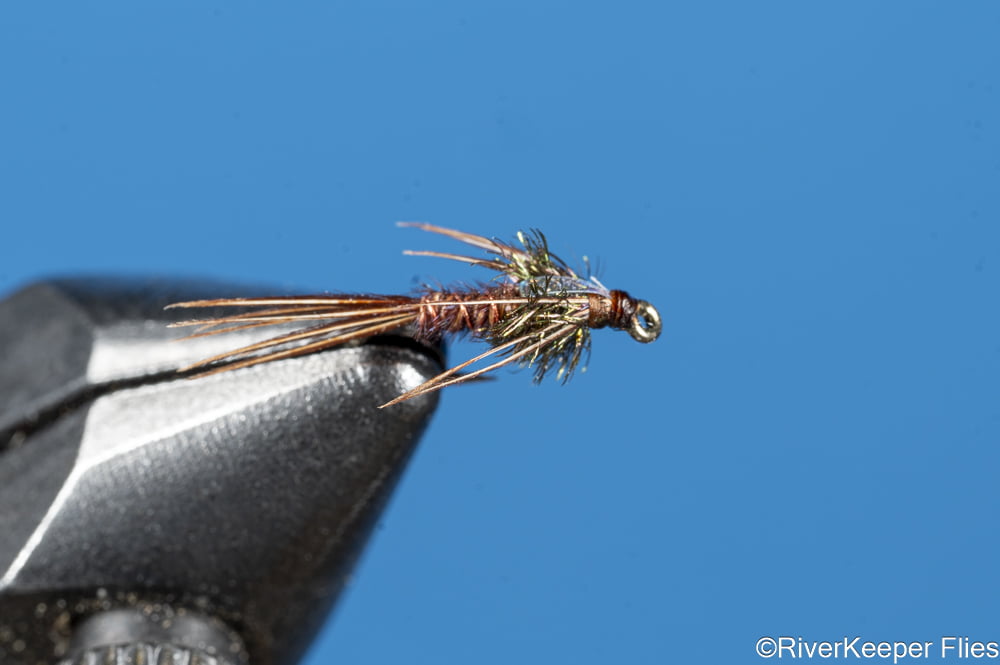

Or the one I use most, a Pheasant Tail Perdigon.
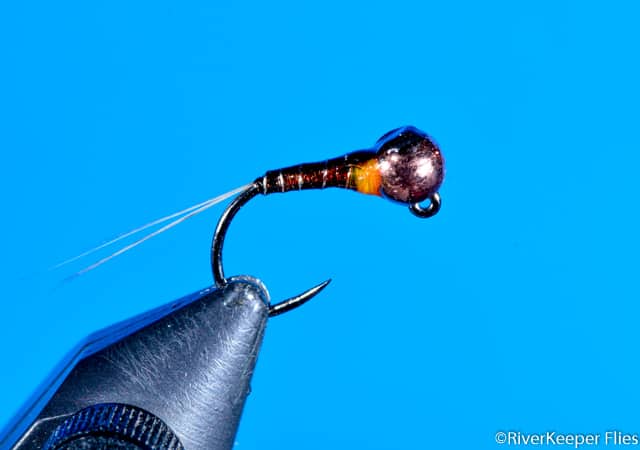
What variations have you made to this classic nymph?
Enjoy…go fish!


I have always wanted to tie one of the originals and fish to compare – this jogged my neuron to get up there and tie – Thanks John
Interesting that wire is such a major and integral part of the tie in the original. Now, I want to tie one just like it. Thanks for the reminder on the old books!