Having trouble finding fish? Locating the right holding water will increase your success immensely. Here are three tips to increase your fly fishing success. In today’s post, I’ll briefly discuss seams, boulders, and foam.

Look for seams
Perhaps you’ve heard the term “seams” before, but didn’t know exactly what it meant.
A seam is where fast and slow water meet. It’s perfect for trout because they feel safe hiding in the fast water, but can move easily to the seam and eat insects the river delivers to them. Think of it as a conveyor belt delivering newly hatching bugs to fish.
A couple of weeks ago, we walked along our home waters and the wind was blowing all kinds of tree “stuff” into the river. We’ve learned it’s almost impossible to fish dry flies with all the debris. Instead, we walked the river hoping to find rising fish and enjoying the scenery.
What I found instead were all these pine needles caught in a small eddy next to the main current. I thought it showed exactly where the seam is. Take a closer look at the image. The tan area in the middle of this image is pine needles. Above the pine needles you’ll see multiple lines in the water. Those are the micro-currents making up the main flow of water. Upon closer inspection below the pine needles, the water appears smoother. That’s an eddy. The spot between the main current and eddy is the seam.
Returning to this spot about a month later, my fishing partner caught this beauty in the exact spot, right in the seam.

Find boulders
It’s amazing how many fish we have caught by letting our fly float to and around large mid-stream boulders. Lots of fly fishers fish behind rocks. It’s a great place, for sure. But don’t neglect the other areas too. Concentrate immediately in front of the boulder and along the “shoulders”, that area on either side of the rock.
The following image is a perfect example. It’s on the Stillwater River, MT.
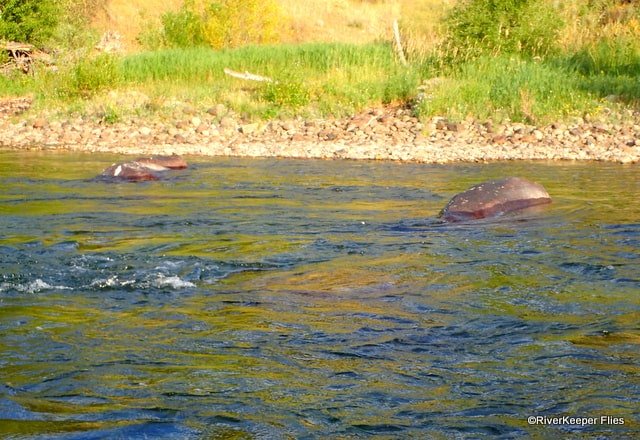
The exposed rocks will hold fish too, but in this run, the submerged rock in the center was the hot spot. Every time we fished this section, trout rose from the front and side of this rock.
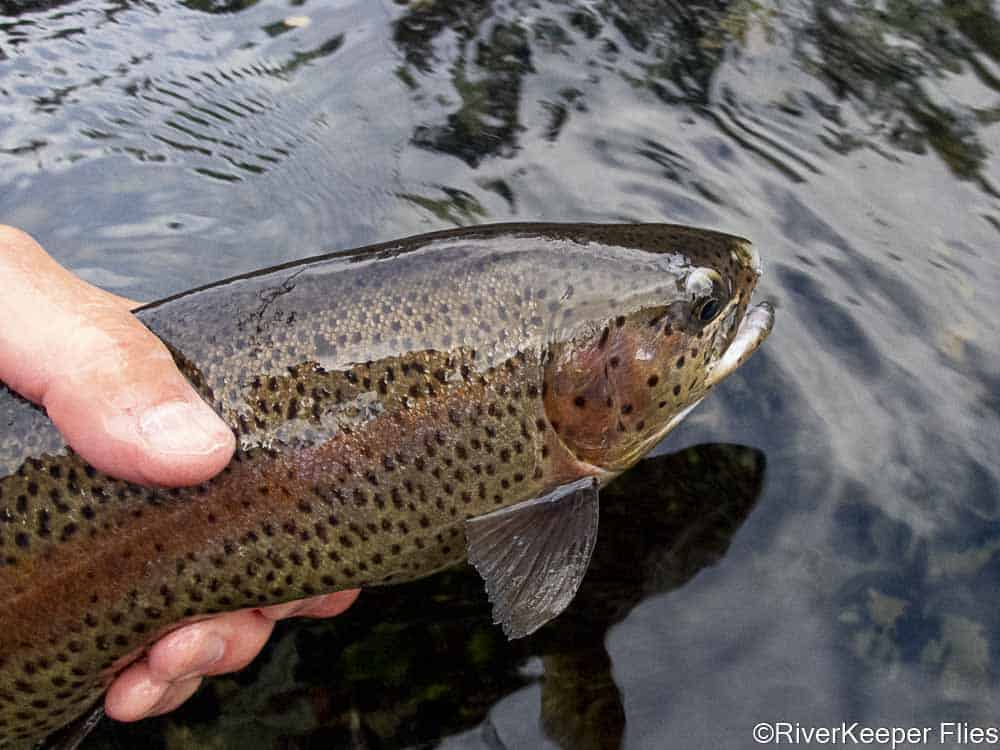
I’ve been working those areas on my home water when I don’t see rising fish and have been surprised and rewarded. I never saw fish rising to eat. I was blind casting in the hopes of raising one. Here is a 14″ I found.
Fish the foam
Have you ever heard the expression “foam is home”?
For some reason, foam forms on the river and gathers in eddies and along seams much like the image of pine needles above. Here are some examples to prove the point.
The image below is on the Elk River, BC.

Whenever I see a soft spot just off the main flow of the river with foam in it, I stop and observe to see if any fish are rising. This small eddy is a perfect location to capture bugs. I think foam offers them protection from predators, like osprey. For some reason, they just feel safe. And it hides your approach as you sneak close to present your fly to a willing trout.
Patience is key. You may see subtle rises or a large mouth rise from below like an orca. It’s exciting to be rewarded for your patience.

How about another example from the Bitterroot River, MT? I stopped to watch for rising fish and sure enough, I would see a nose poke through the foam multiple times.

And the Rainbow Trout eating there.
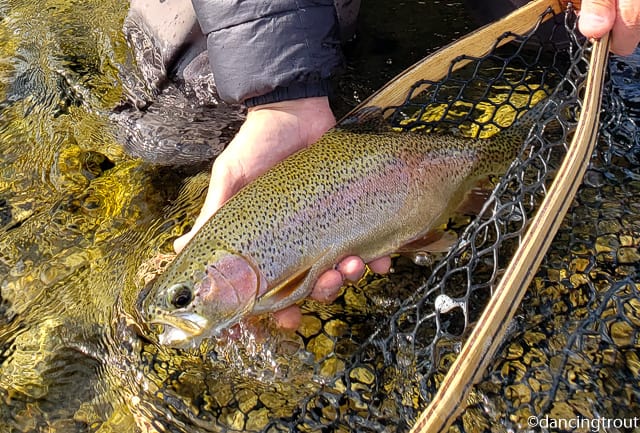
These is a spot on my home waters where fish can be observed eating in the foam line. The foam line moves in and out with the current and fish move with it. I’ve found if I cast to the clear water, I seldom hook fish. It taught me to “fish the foam”.
I hope these three tips help increase your fishing success.
Go fish, stay safe!




John – Great reminder! We are all tempted to cast to the far bank on occasion rather than look for the good water at our feet.
John great newsletter thanks for sharing
Pretty elementary considering the type of readers you have. :-))