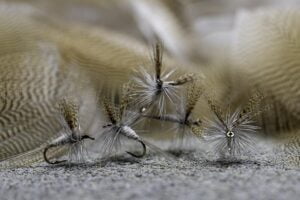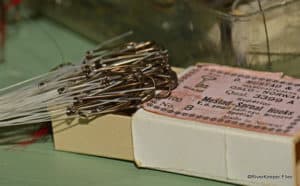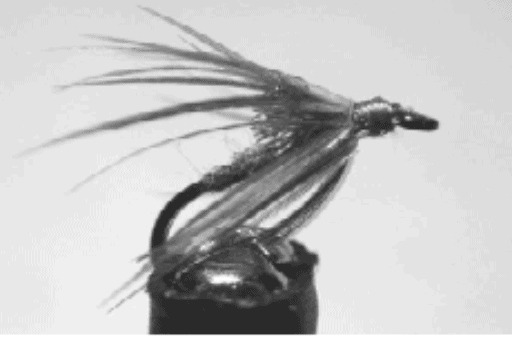
This week’s Throw Back Thursday Fly post are two flies from the Astorga Manuscript.

These two flies were tied by a friend who loaned the book to me.

The El Manuscrito de Astorga by Juan de Bergara, a cleric from the city of Astorga, recorded some of the Leónese fishing system in a manuscript written in 1624. That’s 29 years before Izaak Walton published The Compleat Angler in 1653. Think about that for a moment!

The Principality of Asturias is a region of northwest Spain and known for its rugged coast, mountains, religious sites and medieval architecture. Astorga is a town in the Asturias known since Roman times for its rivers.
This book was created and edited by Preben Torp Jacobsen of “Flyleaves”. Written in Spanish, the book translates the manuscript into French and English for the first time. And that happened in1984. So where was it all that time?
After a long search the Astorga document was found lying unnoticed in a private library belonging to the heirs of a distinguished citizen of Leon, D. Julio del Campo.
In 1959, the manuscript was handed over to the regional Government of the province of Leon, which in 1964 presented it to the Head of State, general Franco, who indeed was a keen angler. What happened to the document after that is not known, but it is believed to have perished with the burning of a great part of the library left by the late Head of State.
Jacobson enlisted the assistance of many Spanish experts to translate the document. We are the recipient of their hard work.
The original manuscript was only 14 pages and provides directions to tie 24 flies. Here is an example:
There are three kinds of Longaretas. The first one, if the month of January, has a blue dun negrisco (cock hackle); then a light pardo of the rabbit’s fur shade, then another negrisco (hackle) like the first one. Body of dark fawn faded silk. White ribbing thread. They can be fished with till April.
The flies in the manuscript are considered the first list of artificial flies.
Do the math…it was written 396 years ago!
Enjoy…go fish, stay safe!