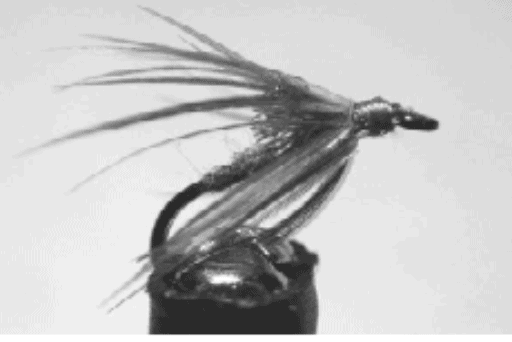
This week’s Throw Back Thursday Fly is the Light Caddis Variant.
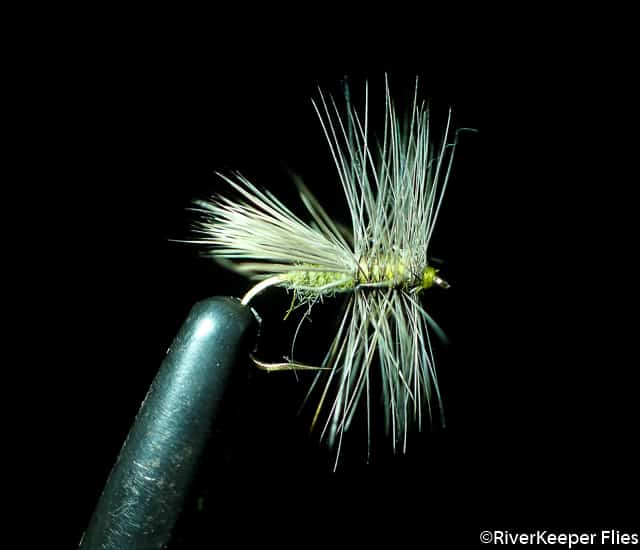
This is a fly I found while I was in Hamilton, MT to participate in the Cast One for Hope fundraiser.
We stopped at Chuck Stranahan’s Flies & Guides to see what we could find.
While waiting to talk with him, I checked out some flies in the bins. I was impressed at the quality of flies I found. Either he ties them or has a group of local fly tyers tying his flies. This sign caught my eye and really summarizes it well.

We ended up having a nice conversation with Chuck. He has been in Hamilton, MT a long time and I asked him to pick out a few flies that I might use for some of my Throw Back Thursday Flies.
The Light Caddis Variant is one of his favorite flies and I decided to start with it.
Here is a description I found on his WEBSITE about the fly
My all-time favorite, most productive fly. Does exceptionally well for early season limnephiledae, the doubles for little yellow stones. Dances on the water and invites strikes. A good searcher pattern any time. Equally effective on flat or rough water.
Chuck Stranahan
Many times, fly tyers use the word “variant” to describe a fly they’ve seen and changed slightly and renamed the fly. That wasn’t the case here. Chuck stated the word “variant” designation was from the Catskill tiers. The variant style uses a short-shank hook with the front half of fly tyed using oversized hackle.
Chuck developed the fly in 1967 in California. He was watching Mother’s Day caddis begin to hatch. He caught one of the caddisflies and held it up by the wing tip and saw it flutter. What he saw was a beating halo of wing around a short stubby body.
He ties the fly with a wing flared 180 degrees into the hackle collar to create the illusion of a beating wing.
Other color variations of the the Light Caddis Variant include tan, green (to imitate a Grannom}, and dark (to imitate the Mother’s Day Caddis).
The hackle utilizes a mixture of dun, brown and grizzly to make multi-colored hackle, depending upon which fly he’s trying to imitate. He likes to use a mixture of grizzly dyed golden ginger and grizzly dyed blue dun for many of his flies.
Most of the flies he developed are not a single color for the body or hackle. He is a firm believer of creating color with a combination, much like an artist would do. Think of all the colors you can find in peacock herl. That’s the concept he uses for his flies.
He’s also a firm believer in using UV materials to tie his flies. Fish can see UV and he believes it’s a trigger for fish to eat your flies.
Here are the colors he mixes for the bodies of his flies. They are colors of Wapsi Antron Dubbing:
- Yellow – Pale yellow with bright yellow
- Tan – golden tan is a blend already
- Olive – chartreuse, med or dark olive, golden olive
- Forest green – the color black has peacock mixed with it
Chuck bought an existing shop 32 years ago named the Frustrated Fisherman. He changed the name to Riverbend, but had problems with other types of businesses using the same name. In addition, he would go to trade shows under the Riverbend name and told people his name. People would drive through Hamilton specifically looking for him, but couldn’t find a shop with his name in the title. That’s when he decided to change the name of his shop to – Chuck Stranahan’s Flies & Guides.
He stated his fly shop is the longest running shop under continuous management west of the Continental Divide in Montana, a fact he’s proud of. Other fly shops might have been around longer, but have been sold several times. His shop has been in four different locations, but has stayed in it’s current location for the last 10 or 12 years.

Here is a portion of Chuck’s bio from his WEBSITE:
He began fly tying at eight, and was tying flies commercially at age twelve. He fly-tied his way through college as an Orvis commercial fly tyer and through a ten-year career in education, before opening a full-time fly shop in 1979.
He learned the fly tying craft from masters such as Cal Bird, Polly Rosborough, Darwin Atkins, and Andre Puyans. His style blends their techniques with his own innovations. His fly patterns are becoming standards throughout the West, and are featured in books by Jack Dennis, Gary LaFontaine, Greg Thomas, John Holt, and Randall Kaufmann.
He learned flycasting and fly rod design and manufacture from some of the masters who shaped the sport, beginning as a college student in San Francisco on the Golden Gate Angling and Casting Club ponds. Over the years he fished with many of these same mentors, honing his own skills as an angler.
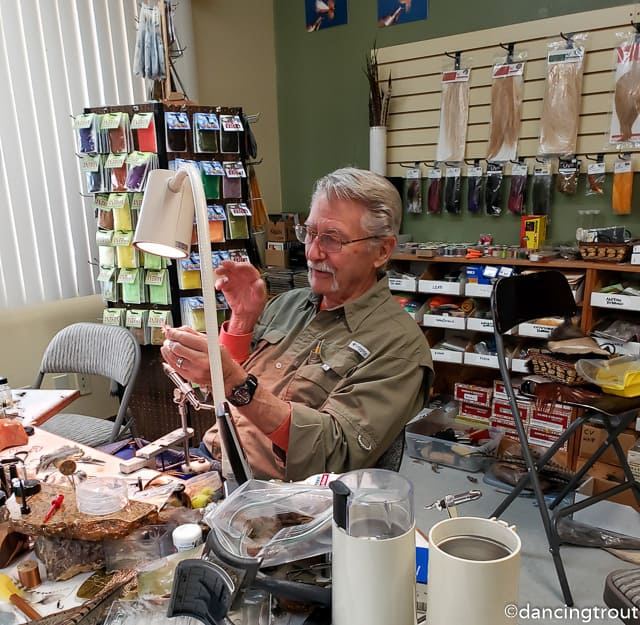
If you are planning to fish the Bitterroot River around Hamilton, MT, I highly recommend stopping by the shop and checking out his quality flies. I hope you’ll be as impressed as I am!
Enjoy…go fish!