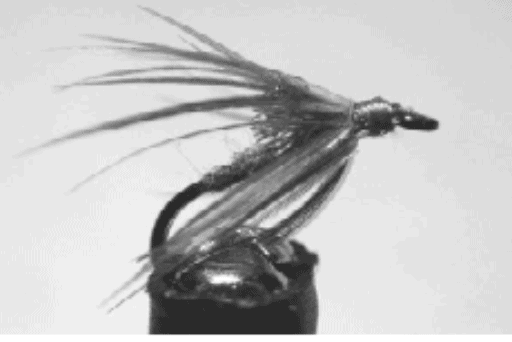
This week’s Throw Back Thursday Fly is Stewart’s Black Spider.
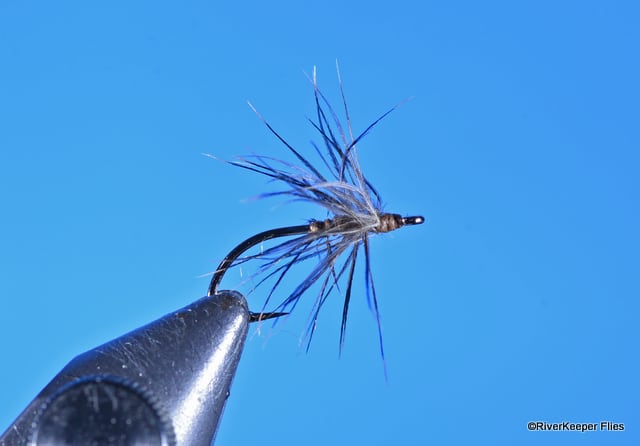
Stewart’s Black Spider is from his book entitled The Practical Angler (1857). Copyright laws no longer apply and you can download the book by clicking HERE. Be sure to check out my Links to Free Old Fly Fishing and Fly Tying Books.
One of my readers asked me if I knew of a specific older wet fly and that one question led me to check out several books, including The Practical Angler (1857) by W.C Stewart. I found three flies that might be what he was looking for; the Black Spider, Red Spider, and Dun Spider. Looks like a perfect setup for this week’s Throw Back Thursday Fly post!
From page 82:
“1st. The Black Spider. This is made of the small feather of the cock starling, dressed with brown silk, and is, upon the whole, the most killing imitation we know. We were first shown it by James Baillie, and have never been without one on our line ever since.
2nd. The Red Spider should be made of the small feather taken from the outside of the wing of the landrail, dressed with yellow silk, and is deserving of a very high rank, particularly in coloured water.
3rd. The Dun Spider. This should be made of the small soft dun or ash-coloured feather, taken from the outside of the wing of the dotterel. This bird is unfortunately very scarce; but a small feather may be taken from the inside of the wing of the starling, which will make an excellent substitute.”
From page 86:
“Dressing a spider is a much simpler operation than dressing a fly, and therefore it is better to begin with it. Having selected a thread of gut and a hook, the next thing is to choose a feather, which, to make a neat spider, must be so proportioned to the size of the hook that the legs of the spider, when dressed, will be about the length of the hook. Before commencing, bite the end of the gut between your teeth; this flattens and makes it broader in the point, which prevents it slipping, a thing very liable to occur with small flies. Next, take the hook firmly between the forefinger and thumb of your left hand, lay the gut along its shank, and with a well-waxed silk thread, commencing about the centre of the hook, whip it and the gut firmly together, till you come to the end of the shank, where form the head by a few turns of the thread. This done, take the feather, and laying it on with the root end towards the bend of the hook, wrap the silk three or four times round it, and then cut off the root end.
What remains to be done is the most critical part of the whole operation: still holding the hook between the forefinger and thumb of your left hand, take the thread, lay it along the centre of the inside of the feather, and with the forefinger and thumb of your right hand twirl them round together till the feather is rolled round the thread; and in this state wrap it round the hook, taking care that a sufficient number of the fibres stick out to represent the legs; to effect this it will sometimes be necessary to raise the fibres with a needle during the operation. Having carried the feather and thread down to where you commenced, wrap the silk three or four times round the end of the feather, and if there is any left cut it off, and finish with a succession of hitch-knots, or the common whip-fastening. If the legs of the spider when dressed are too long, there is no remedy for it; cutting injures rather than improves them. This is a very rough and simple mode of dressing a spider, and does not make it so neat as if the feather were put on by a pair of nippers, but it is more natural-looking, and much more durable, as the feather is fastened on by the thread the whole way down.”
I tied the fly substituting 6/0 brown Uni-thread for the normal silk and a starling hackle on an Alec Jackson North Country Fly hook.
Enjoy…go fish!