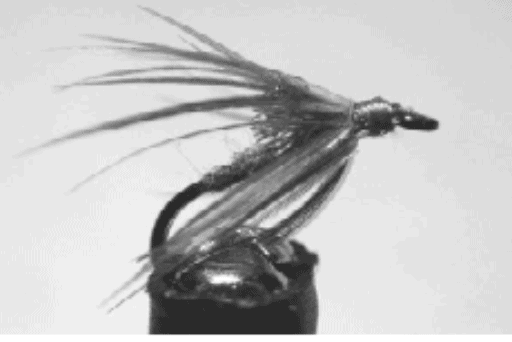
This week’s Throw Back Thursday Fly is the Deschutes Demon TBT.

The Deschutes Demon was created by Don McClain of Don’s Tackle in Portland, OR in the 1960s. It’s one of the flies listed in John Shewey’s book Classic Steelhead Flies (2015) where he mentions Don’s wife Lola who developed another popular steelhead fly, the Deschutes Skunk. Both Lola and Don were professional fly tyers and Don built custom glass rods as well.
Trey Combs lists the Deschutes Demon in his classic book Steelhead Fly fishing and Flies (1976).
He explains how the Deschutes Demon came about:
Catching summer steelhead with a floating line is nothing new to us. I have been taking them for longer than I like to admit, and Lola has been catching them for the past twelve to fifteen years.
First, I would like to point out that, while I may say we catch summer steelhead on a dry fly, technically this is not true. To me you either fish with a floating or sinking line, and we use a floating line. Our fly patterns are not tied as standard dry flies, but we fish them mostly on the surface. We cast, quartering downstream, and work the fly across the surface, slightly twitching the fly. During the day we use flies tied sparsely to ride subsurface. When the shadows cover the water, we use our standard tie so it will ride in the surface. After the sun goes down, we use these flies tied extra bushy so they will make a wake. All three systems work.
Although my McClain’s Fancy readily took summer steelhead, it didn’t take summer steelhead fly fishermen. ‘What I need is an eye-appealing fly that will please fishermen and steelhead,’ I told Lola, as I stuck a 2X long No. 6 hook in my vise and picked up my bobbin. As I sat contemplating, my mind kept going from a Bucktail Caddis to a Golden Demon. Both of these patterns are great, but someone else dreamed them up. What I produced is a hybrid, and, because I use it mostly on the Deschutes, I named it the Deschutes Demon. It doesn’t represent any specific thing, but seems to match everything. Best of all, it has eye appeal.
The original fly pattern as listed in Combs’ book is:
Tail: Hot orange saddle fibers. Body: antique gold wool ribbed with medium embossed gold tinsel. Hackle: Hot orange saddle tied down as a throat or “four turns for better flotation.” Wing: Brown deer body fur with white bucktail over.
Enjoy…go fish, stay safe!
(John Kreft is a participant in the Amazon Services LLC Associates Program, an affiliate advertising program designed to provide a means for sites to earn advertising fees by advertising and linking to amazon.com.)