This week’s Throw Back Thursday Fly is the Pink Lady, a classic Catskill fly.
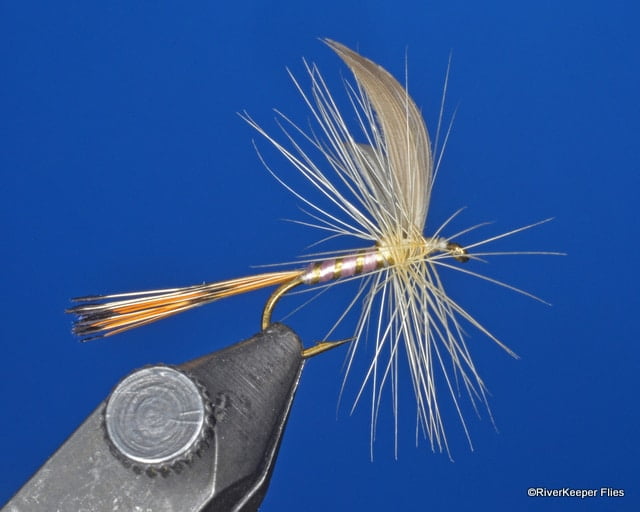
This Pink Lady was tied by Bob Kern at the International Federation of Fly Fishers Fair in Livingston, MT in August 2016. Bob did an amazing job of mounting the wings, utilizing the double-slip quill wing style. He drove all the way to Livingston from Blairsville, GA. He can be found occasionally at the Southern Highroads Outfitters demonstrating and teaching Catskill flies. He is member of the Catskill Fly Tyers Guild.
George M. L. La Branche developed the Pink Lady in the early 1900’s. He tells the story about how the fly came about in his book The Dry Fly and Fast Water, published in 1914.
Here is La Branche’s story in his own words:
“Many years ago, while preparing for a short trip to the stream, I discovered that I did not have a single Queen-of-the-Waters in my fly book. On my way to the railroad station I stopped in a tackle shop and asked for a dozen of that pattern. The clerk was unable to find any in stock, but suggested that I try a dozen called King-of-the-Waters. Although there was, in fact, little similarity between these two patterns except in the name itself, this seemed sufficient to my ignorant mind, and I took them. The following day, upon the stream, my cast of three flies (I was a wet fly angler then) was never without a King-of-the-Waters–and not a fish did I take with it. I attributed my non-success to the pattern of fly, and it never occurred to me at the time that very few fish were taken at all that day, although many anglers were on the stream. The next morning, when I opened my fly book, I found that a great deal of the red dye used upon the silk body of the fly had come off on the drying pad. The body of the fly was now a beautiful pink. Out of curiosity I wet the fly, and the pink body turned a brilliant red. I thought the thing over, and decided that I had stumbled upon an explanation of the failure of the fly to take the day before. The body of the fly originally was red and was evidently meant to appear so to the trout. When wet, however, it had turned a muddy brown. With most of the colour washed out, the fly turned a darker shade when wet, became really red, and stayed red. I determined that if this was the colour the trout wanted, they should have it, and I soaked a half dozen flies in a tumbler of water, pressing and squeezing every bit of dyestuff out of them that I could. They were all pink-bodied when I had finished with them…”
Several years passed, but La Branche still remembered that fishing day. He continues…
“The pink-bodied fly in it’s present form – that is, tied in accordance with my own practice – has upright wings and a tail, and in appearance is not unlike the Red Spinner. It has been dubbed the “Pink Lady” by one of my friends, a name that it seems destined to carry, as it has already appeared by that name in a tackle dealer’s catalogue. As to whether or not the trout is attracted by the brilliancy of the body, or by the rib of gold tinsel that gives it a fillip other flies lack, or because it bears a close resemblance to the Red Spinner, I cannot venture an opinion. That it is a taking fly, however, I have demonstrated many times upon the stream.”
Here is the fly pattern as described in La Branche’s book The Dry Fly and Fast Water.
Materials | |
Wings: | Medium starling or duck |
| Body: | Pale pink floss ribbed with flat gold tinsel |
Legs: | Ginger or light reddish-brown hackle |
| Tail: | Three whisks of same |
The Dry Fly and Fast Water is now out of copyright and can be downloaded for your reading pleasure by clicking HERE.
Thanks again Bob for tying the Pink Lady and Red Quill flies!
Enjoy…go fish!