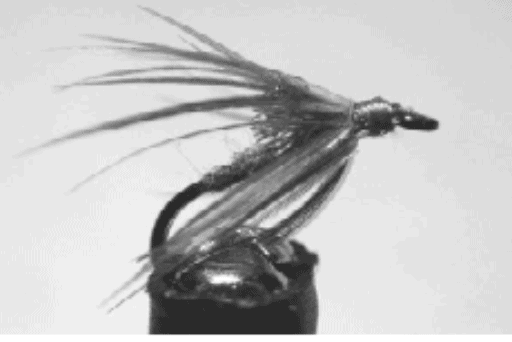
This week’s Throw Back Thursday Fly is the Crossfield, a strip-winged Atlantic Salmon fly.
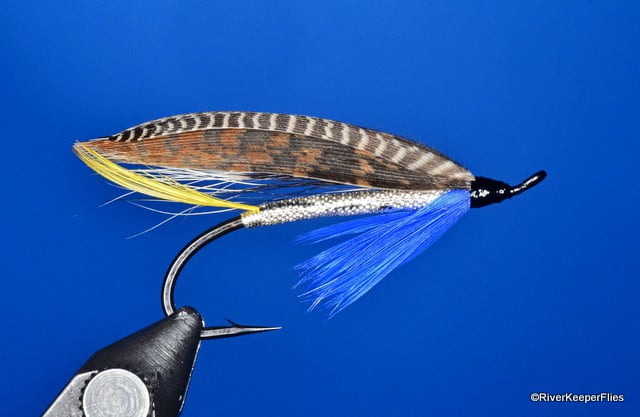
The Crossfield is the second Atlantic Salmon fly I’ve tied from Poul Jorgensen’s book entitled Salmon Flies – Their Character, Style, and Dressing (1978). The first fly I tied from his book is the Blue Charm.
Some quick research finds the Crossfield is a fly from Iceland and originated by Shetney Crosfield around the turn of the 19th century. Joseph D. Bates, Jr. and his daughter Pamela Bates Richards wrote about the fly in their book Fishing Atlantic Salmon (1996). They state the original fly was tied with a Yellow Head, and named the same. Sometime later, the fly was tied with a black head and renamed to the Crosfield for the British fly tyer. (Please note the difference in spelling.)
Angling Iceland provides more information about Shetney Crosfield and his brother Ernest, a well-known British angler of the time. I encourage you to go to their site and read further.
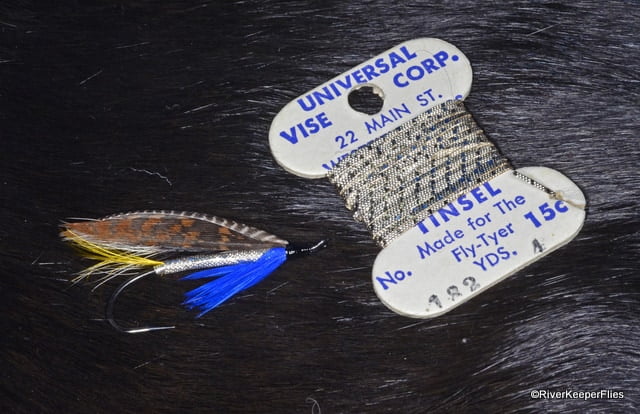
As I prepared to tie the fly, I searched through my fly tying materials to find embossed silver tinsel for the body. I didn’t think I had any, but decided to look through a Ziploc bag. Low and behold, I found an old card of tinsel sold by Universal Vise Corp., which sold for 15 cents!
| Materials | |
| Thread: | Black, prewaxed 6/0 |
| Tag: | Fine oval silver tinsel |
| Tail: | Golden pheasant crest |
| Body: | Embossed silver tinsel |
| Throat: | Medium-blue-dyed hackle |
| Wings: | Black-barred teal over an underwing of brown-mottled turkey tail |
| Head: | Black thread |
I tied this fly on a #2 Dai Riki 2929. While the fly pattern doesn’t include a small bunch of white-tipped squirrel tail, Jorgensen adds the material to help support the turkey wing.
Enjoy…go fish!



Nice fly. Maybe you can help me.
I have been looking on line for a good biography of Joseph D Bates Jr. and can not seem to find one. Is he the same person as Colonel Bates that I have read about in the book about Carrie Stevens. I an very interested in the history of fly fishing.
Hi John
Thanks for leaving a Comment on my RiverKeeper Flies website.
I am by no means an expert on fly fishing history, but that’s what my Throw Back Thursday posts try to do. I’m happy the Crossfield post helped with yours.
I found this link in The American Fly Fisher journal – Spring 1999. His daughter wrote the piece and it might interest you.
Joseph D Bates Jr: The Collection of a Lifetime by Pamela Bates Richardshttp://www.amff.org/wp-content/uploads/2016/01/1999-Vol25-No2web.pdf
I think you may have sparked a little interest for me as well. I plan to read this article and spend some time reading his book I have in my fly fishing library – Streamers & Bucktails The Big Fish Flies.
Regards
John
Hi John,
Nice web site and nice flies!
I just visited it to take a closer look at your take on the “Crosfield” and would mention to you that though this fly is often spelled with 2 esses (Crossfield), it was named after Sydney Crosfield (with one ‘s’ only) – brother of the renowned salmon fisher and fly tier Ernest Crosfield. By the way, Colin Innes of Inverness in Scotland have written an interesting book on Ernest Crosfield and his flies for salmon: “Ernest Crosfield: His salmon flies and fishing”. Why Sydney’s name is often mis-spelled, too, as “Shetney”, I do not understand – as he was a well known personality in his time, too. As a first rate cricketer – e.g. he is portrayed on Wikipedia.
Kind regards from Denmark – Thomas Vinge – author of books on fly fishing for sea trout and salmon
Thomas
Thanks for the kind remarks about my RiverKeeper Flies website.
I remember tying that fly. It was my attempt at self-learning to tie salmon flies. I borrowed Salmon Flies by Poul Jorgensen from a friend and used his spelling from his book for my post. I appreciate you setting the record straight with name spelling. I re-read the post and noted I did reference the different spelling. I think I was conflicted at the time about which spelling to use for the post, but chose to include the two “ss” to be consistent with the book. Please forgive me as I didn’t consider myself an expert to decide which one to use. It’s remarkable how it can change over time. I’ll add an “update” in the near future to clarify it in the text.
John