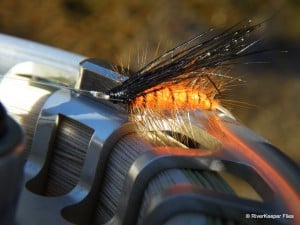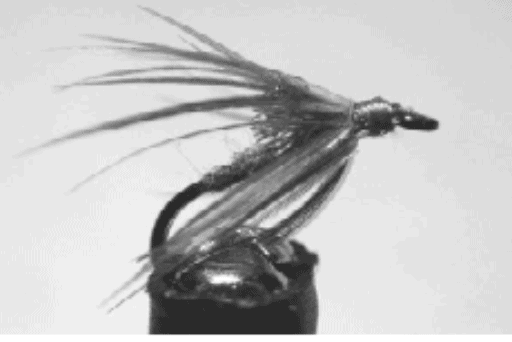
This week’s Throw Back Thursday Fly is the No. 8 Water-hen Bloa.

The Water-hen Bloa can be found in many of the old fly fishing and fly tying books. The first example is from page 24 of Yorkshire Trout Flies by T. E. Pritt (1885)
“This fly is identical with the blue dun of Ronalds, and is indispensable during March and April, and again towards the latter end of the season. It is also a useful grayling fly all through the winter months. No. 9 on the plate is another dressing of the same fly, and is a favourite in Upper Wharfedale. The hackled fly is, perhaps, preferable, as the real fly hatches out mainly on cold, windy days. If the day be warm the insect takes flight immediately on reaching the surface of the water ; but if, as is commonly the case, the day is cold, it lingers on the surface, not completely hatched into perfect form, and is thus easily pounced upon by expectant trout.”
Materials
Wings:
Hackled feather from the inside of a Water-hen’s wing.
Body:
Yellow silk, dubbed with the fur of the Water-rat.
Harfield H. Edmonds and Norman N. Lee list their Waterhen Boa as No. 2 in their terrific book, Brook and River Trouting (1916).
Wings:
Hackled with the smoky grey feather from the under coverts of a Waterhen’s wing. (The darker side of the feather towards the head of the fly).
Body:
Yellow silk, No. 4, dubbed with Mole’s fur.
Head:
Yellow silk.
March to end of April, and again in September.
Personal tying notes:
- Tied on an Alec Jackson North Country Fly hook, #13
- I chose an under-covert quail feather to substitute for the Waterhen
- Pearsall’s light yellow silk thread
Both of these books are available through a free download if you follow the links. They are two of those found on my Links of Links to Free Old Fly Fishing and Fly Tying Books page in my digital library.
Whenever I select an old fly pattern to tie and feature as a Throw Back Thursday Fly, many times I pause because I don’t have all the materials listed in their fly patterns.
I was thrilled when I purchased Robert Smith’s The North Country Fly: Yorkshire’s Soft Hackle Tradition (2015) book. I enjoyed reading his stories of the history of the classic North Country flies.
If you are interested in these flies, his book is a must-have for your fly fishing library. I purchased mine from The Rogue Angler.
Recently, I found Rob’s blog about these classic flies. It was just what I needed to find a substitute for a body of mole. I’m pretty sure I have some mole in my fly tying supplies. I just can’t seem to put my hands on it. Then I read a paragraph from Rob’s post providing information about a substitute for mole. In part, it reads:
If tyers are looking for a more suitable imitation of water-rat dubbing, an alternative can be found in the fur taken from the back of a Pine Squirrel. These Pine Squirrel fur fibres have the right amount of longer staple guard hairs, coupled with the right shade of under-fur to mimic that found on the originally used water-rat fur. Mixed with a small amount of rabbit underfur and you have the best alternative to water-rat. It is well to point out that this longer staple fur is a great benefit when it comes to dubbing the dressing silk, and in many ways negates the use of dubbin wax. As the longer fur fibres adheres and encases the tying silk much easier than the often-used substitute of mole fur.
The Sliding Stream – Waterhen Hackles & Spiders
If you get a chance, be sure to check out Rob’s website – The Sliding Stream.
Enjoy…go fish, stay safe!
(John Kreft is a participant in the Amazon Services LLC Associates Program, an affiliate advertising program designed to provide a means for sites to earn advertising fees by advertising and linking to amazon.com.)