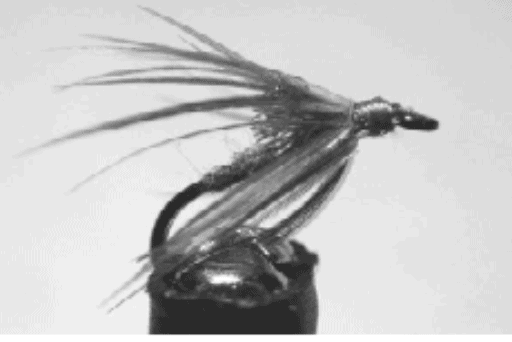
This week’s Throw Back Thursday Fly is Ray Bergman’s Beauty.

This fly was tied by my friend Jim Fisher, the 2011 Stan Walters Memorial Tyer of the Year from the Oregon Council of Fly Fisher’s International. I recently spent a few hours with him for a tutorial on selecting materials and techniques used to tie wet fly wings. He happened to have this fly on hand and I thought it would be perfect for one of my TBT posts.
The Beauty is a Ray Bergman dry fly listed in his book entitled Trout (1940 – fourth printing) on page 22, Plate No. 1.
Bergman was well known for his wet flies, but his book also lists dry flies, streamers, nymphs, steel head and land locked salmon flies.
If you are a regular at RiverKeeper Flies, you recall Bergman’s book includes colored plates to illustrate the dry and wet flies with a description of each fly in the back. It was the first book to provide color fly illustrations.
For other Ray Bergman flies, here is a link to the Ray Bergman Category.
Beauty
Body:
Dark Gray Floss
Ribbing:
Silver Tinsel
Tip:
Silver Tinsel
Tail:
Guinea Fowl
Hackle:
Black
Wing:
Guinea Fowl
Note: The order above is the same as listed in Bergman’s book.
Enjoy…go fish!


These old wet flies might surprise the new generation of anglers if they’d fish them. They worked then, and would work now, for a reason.
Trout can see in the UV spectrum. All mayfly wings, in particular, are highly UV reflective. Caddisflies and stoneflies are also UV reflective. Trout can use UV as a sorting mechanism in finding food.
Many of our common materials are surprisingly UV reflective, and many others, such as peacock herl, are not. And, to confuse us further, most terrestrial insects are not UV reflective.
Silver tinsel is highly UV reflective. So are the white dots on guinea feathers.
Bergman’s Beauty, then, shows the mottled UV pattern that a trout, with blurred but UV sensitive vfision, might see in any number of grayish insects – drowned or emerging or egg-laying stones, caddis, or mayflies of many different species.
This does not mean that if UV is good, more UV is better – or that the absence of UV makes a fly useless.. Sorting it all out – where, and how much – and why trout decide to eat what they eat is still an unending mystery. And that’s as it should be.
Hi Chuck – thanks for leaving a Comment about the Beauty and UV in particular.
John