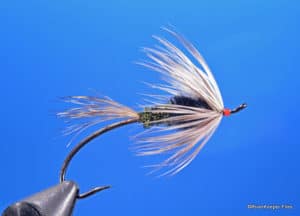
This week’s Throw Back Thursday Fly is the Chartreuse Humpy.

I’ve featured the Humpy as a TBT fly back in April 2015. But I chose this fly to highlight the importance of what fly tyers call “variant”.
A “variant” gives the fly tyer the ability to change something on the original. Many times the change is as simple as a color here or there or perhaps using a new material to the fly tyer. Some people may not like them, but I think it’s part of the creativity of our craft.
I fished the river yesterday with a good friend. While we were waiting for the fish to begin rising (which they never really did) I asked him if he had any old flies for this week’s Throw Back Thursday Fly post. We went through his fly box and I found his version of a Humpy he tied with a chartreuse body. Yup, that will work!
Jim Fisher is a talented fly tyer and received the 2011 Stan Walter Memorial Fly Tyer of the Year. He is known for tying flies with married wings as well as a great teacher in the craft. In fact, I learned to tie the Babcock, a classic Ray Bergman fly from him.

Here is what I wrote about the Humpy in April 2015.
“Some quick Internet research finds the fly was originated by Jack Horner, a Northern Sierra California fly tyer in the 1940’s. The original fly was called the Horner Deer Fly and was similar to a Tom Thumb fly from Canada. The Tom Thumb didn’t split the deer hair wings or have any hackle on the fly.
Curiously, if you search on Goofus Bug, the fly looks exactly the same. The Goofus Bug was credited to Keith Kenyon, a Montana tyer and guide. My research stated he developed the fly in 1944 for the Firehole River.
So a quick recap…the fly was called the Horner Deer Fly in California and the Goofus Bug in Montana. For some reason, the fly’s name changed to the Humpy fly in Jackson Hole, Wyoming.
As with any good fly patterns, variations come along. The Humpy was no exception. The original was tied in yellow and can imitate yellow sallies and golden stones, but you can find a variety of colors including red, green, tan to name a few. Then there’s the Royal Humpy which is tied with peacock and red, the Adams Humpy in gray to imitate mayflies, and the Black Humpy for a beetle. And you guessed it…there is a Double Humpy as well!”
Thanks for fishing with me Jim!

Enjoy…go fish!