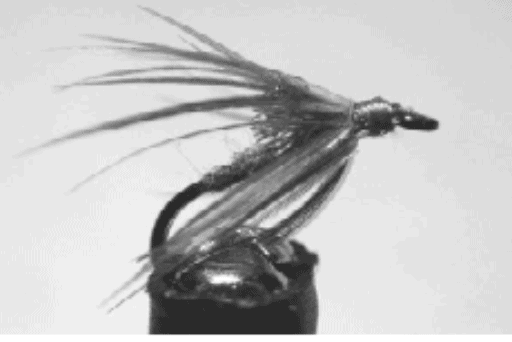
This week’s Throw Back Thursday Fly is Polly Rosborough’s Fledermouse Nymph.

I recently had a customer request several of these flies and thought it would be a good candidate for a TBT post.
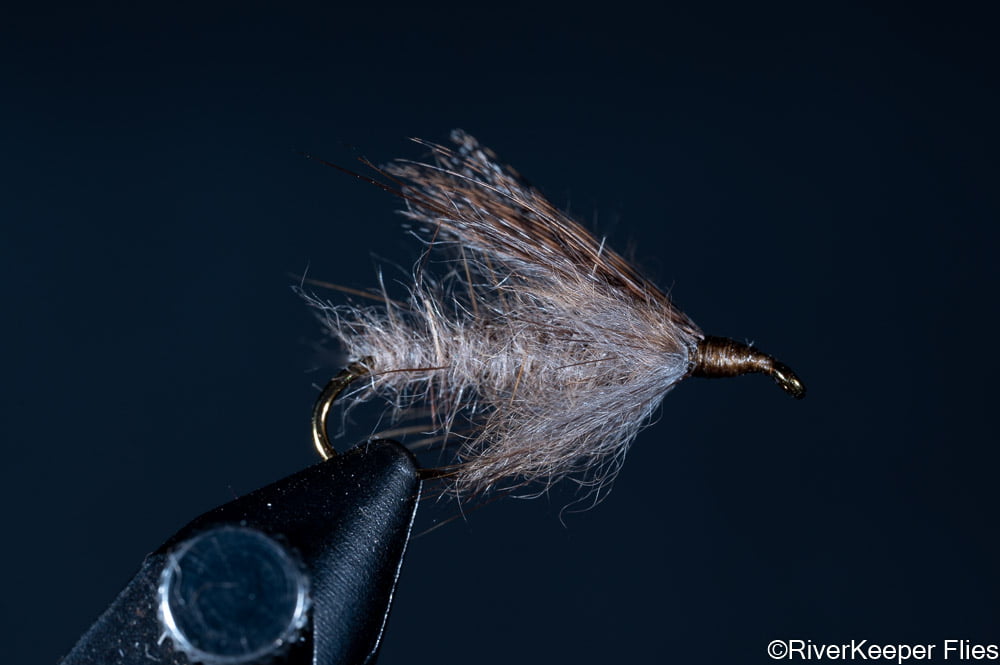
Here is a close-up of the nymph.
Ernest H. “Polly” Rosborough (1902 – 1997) lived in Chiloquin, Oregon and his home river was the Williamson River.
Polly tied a large variety of flies but is probably best known as an author of Tying and Fishing the Fuzzy Nymph (1965).
I didn’t know much about the Fledermouse Nymph, but it’s one of the flies Polly wrote about in Tying and Fishing the Fuzzy Nymph (1965). Four years later, Orvis published the second printing, which is the copy I have.
I think the fly is “old school”, meaning the it only uses natural materials from muskrat or beaver, mink, and jackrabbit (I substituted Hare’s Ear) for the body and collar. Two wings are stacked using barred teal and barred brown widgeon. I’ll bet most of you wouldn’t have these materials on hand to tie the fly. Turns out, I do.

Using all these materials makes a brown and grey fly from body to wing and head.
To describe the fly in his book, Polly begins “This nymph is probably as near all-purpose as it would be possible to devise. It also nearly embodies all the principles of the old “Near Enough” dry fly that it can be used with at least average success in all waters at all times.“
Enjoy…go fish!




I like the looks of this old school type fly. I’m curious if weight could be added or if it is fished with a sink tip.if so, how heavy a sink tip? And John, both my boys are avid bird hunters, so you would be wrong about me having the materials! What do you think of substituting som squirrel or opossum in for dubbing?
Thanks for the Comment Jim.
I’m sure you could easily add weight to the fly. Since I mostly fish dry flies this time of year, I don’t plan on fishing this fly…it’s for one of my customers. Regarding substitutes for dubbing, Polly mentions other alternatives, dyed brown or gray, key colors for his fly.
John
Love the fly, John, although I haven’t tied any for a long time. Thanks for the reminder and inspiration – it’ll give me something to do during high water.
Either Polly told me or somebody else told me that he’d run up to Diamond Lake with a batch of fat #6 Fledermouses (Fledermice?) during midsummer and fish them for dragonfly nymphs. That fly was killer when the lake’s big rainbows were on dragonfly nymphs. I tried it, with extra muskrat to darken the overall shade of the dubbing, makinbg the abdomen portion fat as Polly suggested, and did quite well for both trout and bass when dragonflies were out.
I also played around with olive rabbit in the dubbing, and as you suggest, other wing materials. The basic concept adapts well. There’s something to be said for the mixed dubbing and barred waterfowl combination – it works.
Thanks for leaving a Comment Chuck. I always enjoy reading them!
John