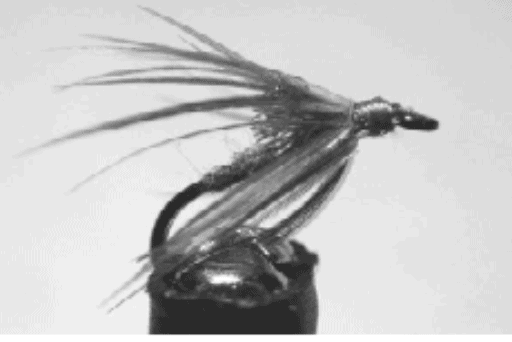
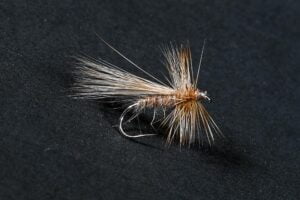
This week’s Throw Back Thursday Fly is the classic Royal Coachman dry fly.
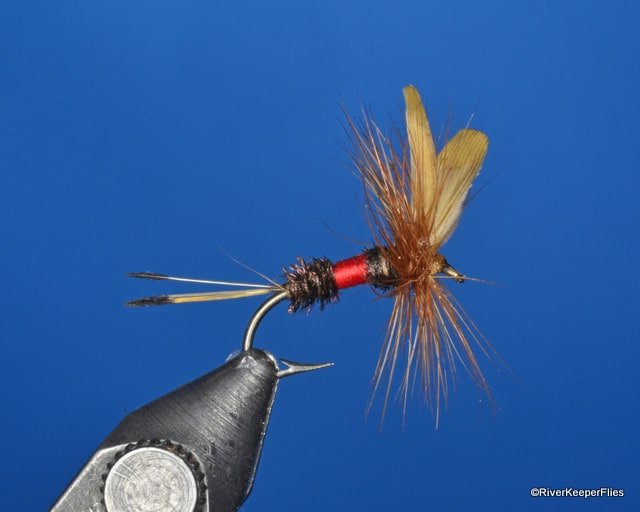
This attractor fly pattern is one that many older fly fishers recognize. It truly is a classic! It was one of many flies I found in a friend’s old fly box.

There are many variations to the first Royal Coachman, which was a wet fly. This Royal Coachman dry fly is one of them. Others include the Royal Coachman Trude, Royal Coachman Bucktail, Royal Humpy, Fanwing Royal Coachman, Royal Wulff, and Royal Coachman Streamer.
Bodies of all the Royal Coachman flies remain the same with peacock, red floss/silk, and peacock. However, tails can be red or brown hackle, golden pheasant tippet, deer hair, elk hair, or moose hair.
Likewise, wings have just as much variation. The fly began with the classic mallard wet fly wing, but other variations include duck quill, hackle points, hen hackle, calf tail, and bucktail.
The Royal Coachman can be found in Mary Orvis Marbury’s book – Favorite Flies and Their Histories (1892). Here is the entry from page 97 listing fly No. 40 (the wet fly version):
“The Royal Coachman was first made in 1878 by John Haily, a professional fly-dresser living in New York City. In writing of other matters, he inclosed [sic] a sample of this fly for us to see, saying: “A gentleman wanted me to tie some Coachmen for him to take up into the north woods, and to make them extra strong, so I have tied them with a little band of silk in the middle, to prevent the peacock bodies from fraying out. I have also added a tail of the barred feathers of the wood-duck, and I think it makes a very handsome fly.” A few evenings later, a circle of us were together “disputing the fly question,” one of the party claiming that numbers were “quite as suitable to designate the flies as so many nonsensical names.” The others did not agree with him, but he said: “What can you do? Here is a fly intended to be a Coachman, yet it is not the true Coachman; it is quite unlike it, and what can you call it?” Mr. L. C. Orvis, brother of Mr. Charles Orvis, who was present, said: “Oh, that is easy enough; call it the Royal Coachman, it is so finely dressed!” And this name in time came to be known and used by all who are familiar with the fly.”
How many variations of the Royal Coachman have you fished?
Enjoy…go fish!


Hello!
I am working on my second http://www.royalcoahman.se
The new one will be soon http://www.royalcoachman.eu
I had flyfishing shop in middle of Stockholm City, Sweden 1980 to 1997.
I do have 18 family members of Royal Cochman.
If would be possible to send to you some pictures, I would did it but it is imopossible here.