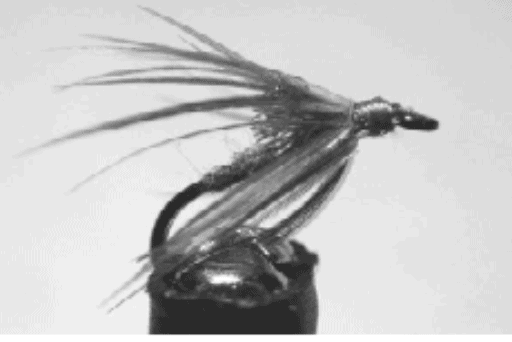
This week’s Throw Back Thursday Fly is about the Adams fly pattern history.

The Adams was one of my first Throw Back Thursday Flies, posted in August 2014. I consisted of one image of a fly I tied many years ago (below), one sentence, and a link to a video.

I’ve come a long way since 2014, providing more information about historic flies. I don’t pretend to know everything about these flies. I conduct a little research to do my part in keeping them alive. As popular as the Adams fly still is, it doesn’t need my help. But I felt I should do a better job with its history.
Since I wrote the original post, I purchased Mike Valla’s Founding Flies (2013). I thoroughly enjoy pulling it out on occasion and rereading a chapter or two.
You guessed it, one of the recent chapters I reread was about Len Halladay and the Adams.
Halladay (1872 – 1952) lived in Mayfield, Michigan and created the Adams in 1922. One account suggests it was tied to imitate a flying ant.
The fly was named for Charles Adams, an attorney and Judge from Ohio who was an avid dry fly fisher. Valla goes on to relay several stories about how the fly was developed. The first is told by his daughter, Edith Halladay Blackhurst. She stated Adams was fishing across from their hotel at Mayfield Pond and asked Halladay to tie a fly matching what was hatching. Halladay knew the fly and tied one to imitate it. It was quite successful. The next day it was named the “Adams”.
Adams’ son Lon wrote to Ray Bergman in response to an article in Outdoor Life (May 1937), where Bergman stated its history is unclear. Lon says his father had asked Halladay to make a variation of the Gray Palmer by attaching wings.
To say the history is interesting is an understatement. You’ll need to find Valla’s book for the other variations. I think I’ll go with Edith’s version.
Halladay used Chadwick’s wool mending yarn for the body material, Golden Pheasant tippet for a tail and brown and grizzly hackle pulled from Rhode Island Red and Plymouth Rock Grizzly roosters he raised.
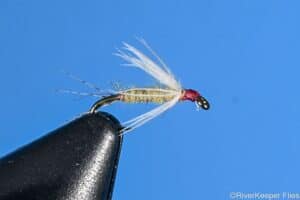
Most fly pattern sheets I’ve seen use muskrat for the body, which is what I used in the fly above. This image is the same fly, but with the wings pulled flat to imitate a spinner.

Halladay tied the fly for many years and added variation with red and yellow bodies. According to his grandson, Halladay tied his last Adams fly on Thanksgiving Day, 1952.
His grandson relays the story in the following three-part YouTube videos.
Check out the 2:48 mark where his grandson shows the fly tying table and tools used to tie the first Adams.
Enjoy…go fish, stay safe!
(John Kreft is a participant in the Amazon Services LLC Associates Program, an affiliate advertising program designed to provide a means for sites to earn advertising fees by advertising and linking to amazon.com.)



My 2 favorite dries 20 parachute and 16 parachute Adams. Also one of the first fly I learned 50
Years ago. Size 10 works great during grey drake hatch. Had great day on Crooked today. Best fly Mercers Midgeling size 18. Nothing my rising
Well done, John. I’ve never seen the video before. Wonderful to learn the details of the history from the Halladay’s grandson. Thanks for sharing.
Thanks John, having been raised in Michigan, I found your post especially interesting.
Ron
”John, the presentation was outstanding, the video is just right-on. well done as usual. jc